

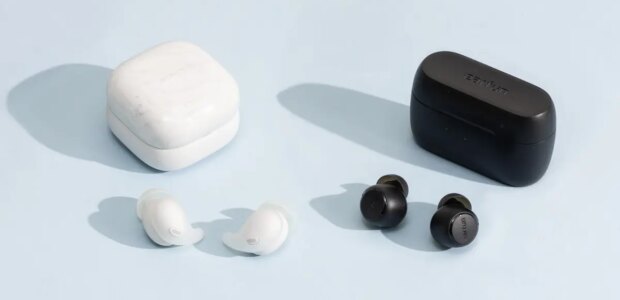

This guide focuses on all-purpose wireless earbuds. We have other guides that focus on earbuds designed to excel at a specific task, such as noise cancellation, gym workouts, or running. We also have a guide dedicated to open-ear headphones for people who do not like how traditional earbuds feel in their ears.We’ve tested more than 500 sets of Bluetooth earbuds to date, so we can’t list every competitor here. But we keep a running list of previously tested earbuds.1More Q20: This inexpensive set had confusing controls and barely any noise cancellation.1More Q21: In our tests, the ANC performance was average, music sounded dull and flat, and the microphones created a garbled mess when we had any noise around us.AirPods 4 and AirPods 4 with Active Noise Cancellation: If you can’t stand the feeling of sealed earbuds and want some noise cancellation, the ANC pair is the only option out there. For everyone else, we think you can get better performance from our picks. Read more of our thoughts.Audio-Technica ATH-CKS30TW+: The ANC was mild, and the sound was flawed in our tests. With the bass boost turned off, hip-hop songs sounded distorted. When it was on, the sound was muddled. Both the earbuds and the case are smaller than average, which is nice. But the earbuds’ wingless design likely won’t be a good fit for small ears, nor will they stay put for workouts.Baseus Inspire XP1: This set has the tuning of Bose earbuds, but the quality of the drivers (and thus the sound quality) isn’t on a par with that of Bose earbuds. Neither is the ANC performance, which is just average. The microphones can handle a light breeze, but they may give your voice a raspy quality even in a quiet room.Bose QuietComfort Ultra Earbuds (2nd Gen): This pair is a slight improvement over the first-generation set. The ANC continues to be superlative at reducing airplane noise, and Bose has addressed the call-quality problems of the original. However, the earbuds remain very large, so people with medium or small ears are likely to feel discomfort or fatigue when wearing these earbuds for several hours. This pair is really worth its $300 price tag only for people with large or pressure-tolerant ears who prioritize noise cancellation.CMF Buds Pro 2: The charging case doubles as a remote control for the earbuds, performing most of the actions you’d normally access through the tap controls. It’s nifty, but your phone can provide the same service. In our tests, this set had middling ANC and a design that could be difficult for people with small ears (due to the shape) or large ears (due to the size of the included tips) to get a proper fit. The sound was quite nice, though it leaned toward being bass-forward. The app provides customization for the earbuds and case control, but it was buggy.Creative Zen Air SXFI: This set has several commendable attributes, but it also exhibited a few flaws in our testing. The ANC was effective on airplane noise, and music sounded quite good, especially when we found the right EQ preset for our tastes. The microphones sounded clear on calls, and the build quality felt substantial for a pair under $100. However, the hear-through mode sounded unnatural, and the earbuds are chunky at the top, which could make it difficult for people with smaller or sensitive ears to get a good fit. In a competitive category, those minor flaws were enough to keep this pair from being a pick, but if the flaws aren’t dealbreakers for you, the SXFI set is worth considering.Dell Pro Plus Earbuds EB525: If you need a pair that’s Microsoft Open Office Certified in order to meet a workplace requirement, the EB525 set ticks that box, but we found its performance to be subpar for the price. The ANC was below average, high frequencies sounded coarse, and the squeeze/swipe controls were fussy. The USB-C dongle, which enables you to connect to PCs without Bluetooth pairing, is nice, but we prefer the JLab Epic Edition for that. The microphones do a decent job of reducing background noise, but the noise-reducing filter can make your voice sound like you’re underwater.EarFun Air Pro 4: This set is our budget pick for best noise-cancelling earbuds. We like this pair a lot, but it usually costs around $30 more than the EarFun Free 2. Unless noise cancellation is a priority for you, our budget pick is the more economical option. For about $20 more, the newer Air Pro 4+ delivers a slightly more refined sound and improved battery life, plus a smaller case and better dust resistance. But unless any of those attributes are crucial to you, we don’t think you need to spend more.JLab Go Pods ANC: Considering that this set is priced around $30, it performs surprisingly well. The ANC is effective enough to be helpful on a plane. In our tests, the sound was pleasant, but male vocals sounded slightly muffled due to a bass boost that was too wide. With customization, the touch controls can provide the full suite of headphone actions. The small charging case has a built-in USB-C cable, and the earbuds are rated IP55 for water and sweat resistance. Downsides include a lack of sidetone on calls, touch controls that don’t issue a beep to indicate activation, and microphones that give your voice a compressed quality. Also, the build feels plasticky.JLab JBuds Pods ANC: The adjustable ANC was slightly above average in our tests, but this pair produced blurry, muffled low frequencies and strident highs that we could not fix in the app-based EQ. We also found that the microphone’s compression made our voices sound oddly robotic.Noble FoKus Amadeus: This set sounded fantastic, with crisp, delicate, detailed highs and a wide soundstage supported by lows that extend down to 20 Hz without thudding, rattling, or distorting. The app has a responsive EQ interface that enables meaningful adjustment. However, the earbud chassis is very thick and heavy, so even though Noble includes six sets of tips, people with medium or small ears may struggle to get a fit secure enough to keep the earbuds in place for long periods. The ANC was only moderately effective over a narrow band of frequencies, but the passive isolation was quite good. The controls are fussy; the hold function will turn off the earbuds if you press it for a second too long.Nothing Ear A: This is the most affordable earbud pair in Nothing’s Ear line. The ANC is above average and offers three levels of intensity, as well as an adaptive mode that adjusts to the noise in your surroundings. In our tests, we found the sound to be a bit hyped out of the box — it was not unpleasant, and you have a few ways to adjust it in the app if you wish. The earbuds have a dust- and water-resistance rating of IP54, and the case has an IPX2 rating. Technically, this set offers the full suite of controls if you change the gesture settings in the app, but in our testing the assigned controls often failed to activate. In our tests, the microphones sounded very compressed, especially in noisy environments; you’ll be understood, but your voice won’t sound like yourself.Nothing Ear: The Ear is the midlevel earbud set from Nothing, with wireless charging and a better IP55 rating for the case. The earbuds use ceramic drivers, and out of the box this pair sounded slightly better than the Nothing Ear A in our tests, with a bit more depth to the sound, better restraint and clarity in the bass, and highs that were less harsh and icy. This was the only Nothing pair we tested that didn’t have issues with the controls’ acting buggy when we tried to customize them. The ANC was above average, but the microphones sounded notably compressed on calls.Nothing Ear 3: This is the flagship earbud pair in the Nothing line. Aside from its use of a different driver material, the main thing that differentiates this set from the others is the case, which adds a feature called “super mic” that turns it into a handheld microphone when you are on a call in a noisy area. It’s an interesting idea that works well; my voice sounded significantly clearer when I used the case as my mic. But it felt weird talking into an earbud case like a child pretending to be a TikTok influencer, and the earbuds’ microphones sounded so compressed that, even in a quiet area, the “super mic” became a necessity rather than a novelty. Also, we had the same problems with the customized controls on this pair as we did with the Nothing Ear A set.OnePlus Buds 4: In our tests, this set was stellar for phone calls in noisy locations. The noise-reducing mics did a great job of suppressing background noise and wind without rendering our words incomprehensible. The ANC was above average, and the transparency mode sounded quite natural. Sadly, music didn’t sound quite so authentic. Guitars were muffled, and vocals had a lispy quality.Poly Voyager Free 20: This set had decent low-frequency ANC in our tests, but we found the physical controls to be buggy and uncomfortable to use. Although the microphones handled a light breeze well, they struggled with higher-pitched noises like running water or the whoosh of traffic. Additionally, the firmware updates for the case need to be performed on a laptop or desktop, and the earbuds are updated via a mobile app, which makes it cumbersome to keep the set up-to-date.QCY AilyBuds Pro+: In our tests, the ANC was minimal, which isn’t entirely surprising considering the earbuds’ unsealed design. But we weren’t impressed with the sound quality, either, and the microphone sounded artificial and distant.Soundcore Liberty 5: Although this set has above-average ANC and a natural-sounding hear-through mode, the microphone quality sounded compressed and somewhat rough during our tests. Out of the box, the bass response was bloated; we were able to mitigate the loudness of the bass using the EQ controls in the Soundcore app, but low notes still lacked form and definition. Also, the squeeze controls caused the earbuds to move in our ears, so we were constantly readjusting the fit.Soundpeats H3: This is not a good set for people with small or medium ears, as the hard, lucite chassis is chunky; even people with larger ears may have trouble wearing them. In our tests, the ANC was average overall but useful for airplane noise. However, the hear-through mode sounded unnatural, the microphones made voices sound especially compressed (like an old landline), and the app requires you to create an account to use it.Status Pro X: This pair has intense ANC in a specific range, but very low-frequency rumbles and engine whines can bleed through. The sound is powered by three drivers. We found the mids and lows to sound quite nice in our tests, but the balanced armatures that handle the highest pitches sounded sibilant and piercing — and we couldn’t fix it using the EQ controls. The hear-though mode also struggled with the over-hyped highs, emphasizing everyday noises like keyboard clicks in a way that was distracting and potentially painful to sensitive listeners. It’s a pity, as we really appreciated the full controls and the EQ interface, which allows you to tweak existing EQ presets rather than starting from scratch.Technics AZ100: This is a decent pair of earbuds, but nothing about its performance stood out. In our tests, the ANC and passive noise isolation were good. We found the sound quality to be somewhat dull out of the box, but we were able to adjust the EQ controls to get a pleasant balance, though some people might detect a hissing quality in the highest frequencies. The microphones do a passable job of reducing background noise, but your caller may find that your voice has a cupped-hands quality. The touch-based controls were finicky at times, and the earbuds have a thick, rounded shape that may be challenging for people with smaller ears to keep in place.This article was edited by Adrienne Maxwell and Grant Clauser.
Source link