

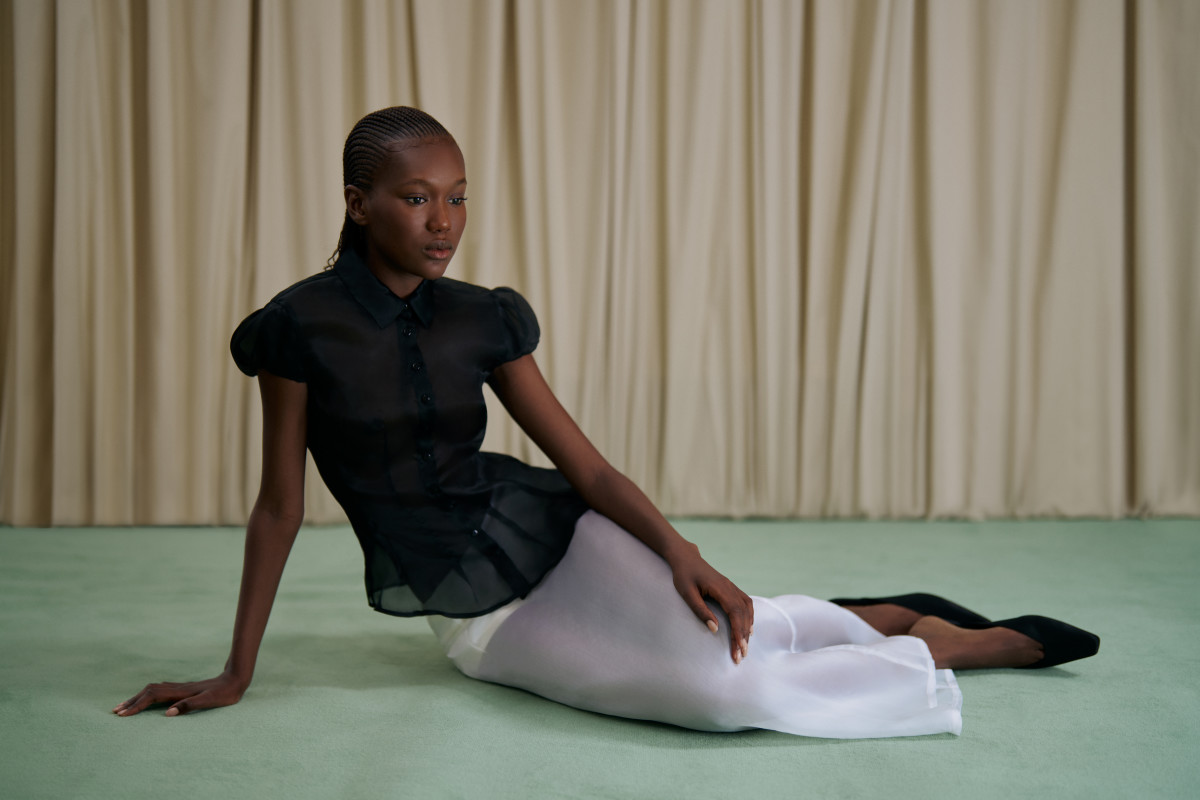

There are still many misconceptions about “French Girl style.” Parisian designer Alice Fresnel knows them all too well. For instance, Parisian women don’t regularly wear berets or flaunt around town in miniskirts and tall boots while carrying a baguette, she tells Fashionista. (Please jot that down, Emily Cooper.) Not every outfit needs to feature a stripe, and neckscarves aren’t the only accessory available in their closets. In reality, the sartorial formula is much simpler. “When you’re outside in the streets of Paris, most of the women are wearing a pair of pants or denim and a white T-shirt,” Fresnel says. “There are not a lot of overly fashion-obsessed women in this city, but they all have a wardrobe — a few pieces that they just wear on rotation and pair with anything in their closet. It’s a very easy way to get dressed and you always look put together.”
Alice Fresnel.Photo: Courtesy of Alfie
So when she launched her ready-to-wear label Alfie in 2020, she knew she wanted to create something that reflected what Parisian women actually wear. “There was a big gap in the market of a lot of French brands that play into that cliché image of the Parisian woman,” she shares. “With Alfie, I want to break that cliché.”Six years in, the brand has gained global recognition and a community of loyalists enamored by its truthful approach to French fashion and modern take on femininity. Sharp cuts, soft palettes and structured tailoring punctuate its collections. As Fresnel tells it, she crafts simple, timeless pieces.”My goal with every collection is not to fall into trends,” she says. “I try to design my pieces so that you can mix and match with anything you have from Alfie, even if it’s from five seasons ago.”
Alfie Fall 2024.Photo: Courtesy of Alfie
Alfie also prides itself on quality. Starting out, Fresnel sourced deadstock fabric from a Paris-based fabric wholesaler, Nona Source, which sells leftover fabrics from major luxury brands at reduced prices. It allowed Fresnel to design clothes of the same caliber as high-end designers while keeping the price point in line with the contemporary market. Most garments fall in the $300-to-$900 range. “Alfie is a premium brand, so we really don’t want to go anywhere near these luxury prices,” she explains. “We have our margins to be a successful business, but we don’t want to overprice our items and not be able to sell to the people we want to.”That business savvy speaks to Fresnel’s initial entry into the industry. From a young age, she immersed herself in the arts, including crafts like painting, pottery and, of course, design. But she was unsure how that could materialize into a career. “I grew up thinking you need to know everything about business,” she confesses.
Alfie Spring 2025.Photo: Courtesy of Alfie
So she took the business route: She earned a Bachelor of Business Administration in Strategic Design & Management from Parsons The New School in New York City, followed by a Master’s in Fashion, Experience & Design Management from SDA Bocconi in Milan, Italy.Alfie was the result of an end-of-year project, which was to develop a business idea; hers was launching a clothing brand. Over nine months, Fresnel made a financial plan, found a factory, sourced fabrics and designed and ordered samples. By the time the deadline arrived, Fresnel had created a five-piece collection with a fleshed-out strategic plan for selling and marketing. It only made sense that, post-graduation, she wouldn’t let all that hard work go to waste: “I thought to myself, I should just launch it and see where I can take this and how far it can go, because I’ve already got the contacts and I’ve started the collection,” she shares.What she couldn’t have predicted was the Covid-19 pandemic arriving two months later. Fortunately, with no employees to pay or office space to rent, her operational costs were already low. If anything, the pandemic presented new opportunities to gain visibility.
Alfie Spring 2026Photo: Courtesy of Alfie
Fresnel capitalized on the surge of content creators trying to break into the fashion space. She offered gifting to a handful of French social media influencers she knew. The brand took off among the fashion girlies and, through word of mouth, became popular in London and New York. A turning point for Alfie was its NYC pop-up in September 2024.”That really changed everything for us,” she says. Suddenly, one of fashion’s well-kept secrets was on a lot more folks’ radar. Celebrities including Dua Lipa, Hailey Bieber, Nadia Lee Cohen and Iris Law wore the brand; and retailers Fwrd and Moda Operandi reached out to place orders, which forced Fresnel to rethink her retail strategy.”I was very anti-wholesale in the beginning,” she reflects. She wanted to keep the label small and community-centric, but realized that, to scale and keep her international customers, wholesale was a necessary next step. That U.S. retail expansion has paid off. “I feel like the consumer there, when they love a brand, they’re really loyal,” she says. “They’ll come back every season.”
Alfie Spring 2026.Photo: Courtesy of Alfie
Now that Alfie must accommodate wholesale orders, it has reduced its deadstock fabric use to limited-quantity designs. Sustainability still remains a core pillar of Alfie’s business model. It regularly works with natural fabrics like wool, cotton and silk, and signed Amazon’s Climate Pledge, a commitment to reaching net-zero carbon emissions by 2040. Through the Pledge, Fresnel’s been introduced to “sustainable” fabric suppliers and manufacturers, plus she receives monthly mentorship opportunities.Even though sustainability isn’t heavily promoted in Alfie’s marketing, it has been a draw for some customers. “People ask about it a lot,” she says. “People are definitely more drawn towards brands that make more of an effort [to be sustainable], especially new brands.”Design-wise, the label is still evolving and defining the Alfie woman. Its recently launched Spring 2026 collection is the most assured version yet. “We’re drifting towards what I call ‘the effortless feminine,'” she explains. “It’s not overly sexy, but it’s less and less oversized and menswear-inspired. […] There’s a lot of very spring-inspired patterns and embroidered flowers. It’s really all about this transition of the Alfie woman. I feel like Alfie is becoming more ourselves every season.”
Alfie Spring 2026.Photo: Courtesy of Alfie
As Fresnel plans her next steps, she’s most excited about retail expansion. She’s open to more wholesale accounts, but prefers to limit it to specialty stores or a very select number of large retailers. “As long as it makes sense with Alfie, with the craftsmanship, with our story, I’ll go for it,” she says. “But I definitely don’t want to be sold in a thousand locations across the world.”This year, she’s also eyeing even more pop-ups across the U.S. and Europe, in addition to targeting the Asian market. (Last year, she had a successful pop-up in Seoul, South Korea, and would like to build on that momentum.) Long-term, standalone retail locations are also in Alfie’s future.”With Alfie, I really wanted to design clothes that Parisian women will actually wear on a daily basis, and to take that overseas — to take that to the U.S., to Asia, to the Middle East, everywhere,” she concludes.Do you have an emerging brand you want to share with Fashionista readers? Jumpstart your business with our affordable digital offerings.
Source link