

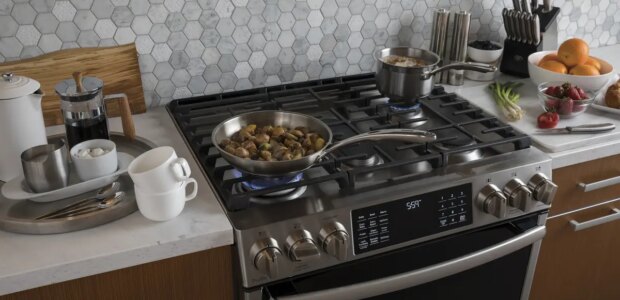

You can cook on any stove. But after talking to experts and comparing more than 60 different gas ranges, we think these are the most important features to look for in a slide-in:CooktopYou should expect a power burner of at least 17,000 Btu, if not a little stronger. With a stronger burner, cookware heats up faster, which saves you a few minutes waiting for big pots of water to boil or a pan to get hot enough for a great sear.You’ll also get a 5,000 Btu simmer burner in the back row for warming, melting, and, well, simmering. Most manufacturers are tight-lipped about how low the simmer burner can be turned down, though Frigidaire told us theirs can get as low as 500 Btu, and we imagine other stoves can reach similar numbers.As for burner layout, some readers have told us they prefer to have the two strongest burners in the front row of the cooktop because those are the burners they use most often. We favored stoves with this layout. But it’s worth noting that some pediatricians recommend that parents of young kids boil water on a back burner, out of sight and out of reach. (This is good positioning for the safety of your own arms, too.) If that’s a concern of yours, there are plenty of ranges with a strong burner in the back row. And in any case, almost any burner will eventually boil water, just not as quickly as a power burner.Almost every slide-in range has five burners. Sometimes the fifth burner is in an oval shape, making it a good fit for a griddle (which sometimes comes with the range). Some people find the fifth burner useful, and others rarely use it; that depends on your cooking habits.And continuous grates, usually made out of steel or cast iron, come standard on slide-in ranges. This surface looks good, makes it easy to slide cookware around the surface of the cooktop, and helps keep larger items balanced better than smaller, single-burner grates can.OvenCapacity matters somewhat, but most slide-ins have an oven that’s larger than 4.8 cubic feet, which is plenty of space for a huge 26-pound Thanksgiving turkey, a 16-inch pizza stone, or all but the very largest sizes of baking sheets and roasting pans. (No 30-inch range we’ve seen can fit a full-size baking sheet.)All but the very cheapest slide-in ranges come with three oven racks. A few of the pricier slide-ins include one rolling rack, which helps dishes glide in and out of the oven.The vast majority of slide-in ranges have some kind of convection cooking mode; essentially, it turns on a fan in the back of the oven cavity. When convection works well, large batches of cookies will bake more evenly, pastry crusts will come out flakier, and roasted meats and veggies will be crispier on the outside and juicier on the inside. Some models add an extra electric heating element near the fan, usually known as “true” convection or European convection, depending on the brand. (We’ll just call it heated-fan convection.) We think it’s worth having some kind of convection mode, regardless of which type. While a convection setting is similar to air frying, many newer models also come with an air fry setting that allows for air frying without preheating on certain racks and temperature settings, which gets you closer to the experience of a tabletop air fryer.Many owners want a self-cleaning mode, particularly a high-heat, “pyrolytic” mode. Some repair technicians say that high-heat cleaning could damage the electronics, particularly if other components like fans or insulation are not in peak condition. But self-cleaning features undergo tests before the ranges are sold. (A self-cleaning mode is also by far the easiest way to clean an oven, though we have tips for making it a gentler, less laborious process.) Some ranges have a steam-based self-cleaning feature, but it’s more for frequent, light cleaning, and not a substitute for a high-heat setting. Our take: You should have the option to use a high-heat cleaning mode on all but the cheapest ranges. If you’re worried about damaging your appliance, don’t use it.Build quality and designFor the models we were able to check out in person, we looked for knobs that are made out of metal, that have a nice weight, and that feel securely fastened to the front of the range, without too large a gap between the dial and the body. We checked for oven doors that opened smoothly with a nice heft, racks and drawers that were easy to slide out or remove, and a sturdy control panel — preferably with a glass touchscreen, because it will look nicer over time than a control pad with membrane-style buttons. If the control pad has membrane buttons, they should feel tight and responsive. We also jiggled the grates around to see how secure they were on the cooktop and how easy they were to remove for cleaning. (All of the units we saw were floor models, so they may have seen more wear and tear than a range in a typical house.)The more finish options there are, the more flexibility you have when designing your kitchen. We gave a slight preference to those with at least three options, though most people seem to be perfectly content with a stainless steel finish.Reliability and customer serviceReliability and customer service are difficult to pin down, but here’s the standard we’ve set for our picks: Owner reviews shouldn’t reveal any clear, consistent pattern of widespread defects, design problems, or egregiously bad product support. For this reason, we favored slightly older and more popular models because they tend to have more user ratings, so we know more about them.We also took into account reliability data from J.D. Power and Yale Appliance. Neither source is comprehensive, though.Over our years of reporting on appliances, we’ve also gathered feedback from repair technicians about the brands that they think are most reliable. But the feedback is highly anecdotal and not very consistent, so we don’t weigh it too heavily in our decisions unless there seems to be a consensus about a specific brand or product.Less-important featuresA wok grate, temperature probe, or any other cooking accessory can be cool and useful, and many ranges come with one or more of these as a toss-in. But you can buy any of them separately, too.Extra cooking modes like delayed starts, food-specific presets, proofing modes or scan-to-cook modes are all fine, but use varies widely. We didn’t go out of our way to avoid models with these extra cooking modes, but we didn’t favor them, either.Wi-Fi connectivity can’t baste a turkey or turn a cookie sheet. It can help you diagnose malfunctions, download new features, or allow you to control the oven settings with voice commands, though we’re still concerned about the potential security and privacy risks of having a connected appliance (plus, they don’t always work in every home). Even if you think Wi-Fi is a little silly to have in a range, it’s common enough now that you might not be able to avoid it for much longer. You can always just choose to never set it up.
Source link