

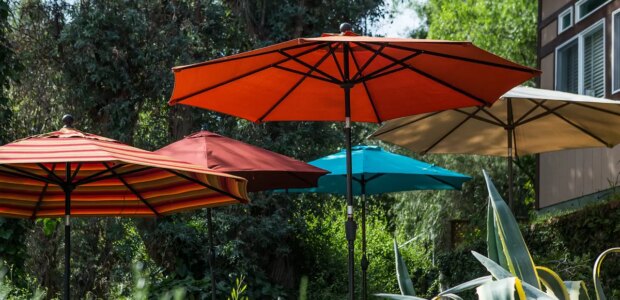

Patio umbrellasWe tried out some umbrellas in a Los Angeles backyard, testing for ease of use, durability, and visual appeal. Photo: Jeremy PaviaA 9-foot-diameter patio umbrella is the right size to shade a small dining set. A lot of outdoor tables come with a hole for an umbrella, but to keep it stable, you also need a base. Photo: Jeremy PaviaWe tried out some umbrellas in a Los Angeles backyard, testing for ease of use, durability, and visual appeal. Photo: Jeremy PaviaLike most “market umbrellas” (the industry term for upright umbrellas typically found in markets and cafés, as well as in backyards), all of the models we tested had wind vents at the top to help avoid damage from strong gusts. A couple of experts we spoke to recommended double wind vents for people who live in particularly windy locations, but double wind vent configurations may add additional cost or lead time on orders.In addition to having at least a single set of vents, we prioritized the following elements:Size: We found that 9 feet is the most common size for patio umbrellas that are meant to be used over a dining table for four. This is also a good size to move around a deck or patio to provide shade for reading, playing, or lounging. Anything smaller likely won’t provide adequate shade. You can size up from there based on your specific needs.Tilt function: A good patio umbrella should have a tilt mechanism that allows you to pivot the entire head of the umbrella to the side while open, so you can stay in the shade for hours as the sunlight shifts. There are two common methods for tilting:A push-button tilt requires pushing a button high on the pole to tilt the umbrella head to one side.An auto-crank tilt automatically moves the head to the side with another rotation of the same crank you use to open the umbrella.We like both types, but prioritized push-button in our picks because it’s usually less expensive. The crank-tilt option is easy and fast, especially for shorter people, who may have to stand on a chair to reach the push button near the top of a push-tilt model’s pole, but the feature can sometimes drive an umbrella’s price up.A Treasure Garden umbrella shown here with a push-button tilt mechanism. You can pay more for an auto-crank tilt. Video: Jeremy PaviaThis now-discontinued umbrella demonstrates an auto crank-tilt style in use. Video: Jeremy PaviaA Treasure Garden umbrella shown here with a push-button tilt mechanism. You can pay more for an auto-crank tilt. Video: Jeremy PaviaAluminum poles: Umbrellas with aluminum poles tend to be widely available and more likely to come with easy-to-use crank-lifting systems and tilting functions. Some of our picks come in versions with wood poles and spokes—which people may prefer for aesthetic reasons—but these often cost more and commonly rely on finicky pulley-lift or lift-and-pin systems.Pole diameter: The umbrellas we looked at all have poles that are 1.5 inches in diameter, a standard size that typically fits through the hole in an outdoor dining table and is compatible with the vast majority of umbrella bases.Fabric: All of the experts we talked with mentioned Sunbrella, a brand of fabric made from a solution-dyed acrylic. That means that color is added to the material at the liquid level, so it retains color far better than standard dying processes. The fabric comes with a five-year warranty no matter what kind of umbrella or outdoor furniture it’s covering, and it has a canvas-like texture.We’ve also tested umbrellas with O’bravia fabric, a solution-dyed polyester that’s less expensive, holds up well, and comes with a four-year warranty. (O’bravia also offers a cheaper O’bravia 2 fabric—with a three-year warranty—which we have not tested.)The canopy on our also-great pick, Midtown’s The Lean 9’ patio umbrella, uses Terylast, another type of solution-dyed polyester. The material comes with a 10-year warranty, but it has a slicker feel than the lightly textured, cloth-like Sunbrella and O’bravia fabrics. (You can order The Lean with Sunbrella fabric, but it’s more expensive.)Cost: Most experts we spoke with think it’s possible to get a high-quality, long-lasting umbrella for around $350. High-end umbrellas from designer brands often cost hundreds, if not thousands, more, and you’re typically paying for beauty rather than added function. Decent umbrellas under $100 are harder to find and are usually made of plastic parts and less-durable polyester fabrics that aren’t solution-dyed.Easy to clean: We rubbed dirt into the fabric and then washed it off, sometimes with just a hose and, if needed, some dish soap, water, and elbow grease. Though the dirt we applied was likely a more aggressive saturation than the layer that coats most outdoor umbrellas over time, we still wanted to see how well each umbrella cleaned up. Both of our picks performed great.Umbrella basesOn the left, a previous pick, the Abba Patio Round Steel Market Patio Umbrella Base, next to our pick, the Article Paima Umbrella Base. Photo: Rozette RagoClockwise from left: The California Umbrella CFMT172 Umbrella Base, the Fiberbuilt Umbrellas Concrete Umbrella Base, the Article Paima Umbrella Base, the Abba Patio Round Steel Market Patio Umbrella Base, and the California Umbrella CFMT160 Umbrella Base. Photo: Katie OkamotoOn the left, a previous pick, the Abba Patio Round Steel Market Patio Umbrella Base, next to our pick, the Article Paima Umbrella Base. Photo: Rozette RagoYou need a sturdy and heavy base to keep a patio umbrella in place, even when it’s positioned in the hole of a patio table. The most common mistake people make with umbrella bases is not buying one at all (they are almost always sold separately) or choosing one that is not heavy enough.Weight: We focused on bases that weighed at least 50 pounds, which experts recommended as the minimum to weigh down a 9-foot umbrella when used with a table. If you’re using an umbrella without a table, get a base that weighs at least 75 pounds.For maximum safety, some experts recommend buying a standalone base that weighs 10 times the size of the umbrella (so a 9-foot-wide umbrella would require a 90-pound base). A sufficiently heavy base is extra important if you plan to leave an umbrella open and unattended.Functionality: Most of the bases we considered have a mechanism that allows the base tube to tighten around the umbrella pole, ensuring a wobble-free fit. We also paid attention to material, knobs, finishes, and assembly instructions.
Source link