

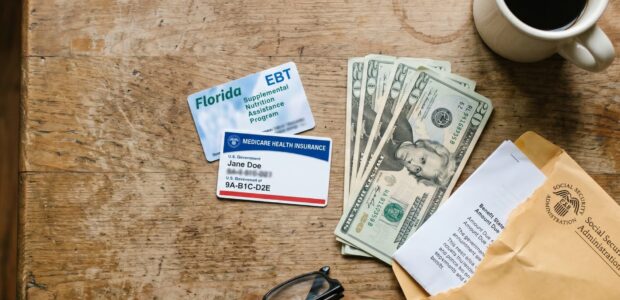

If you’re 65 or older — or you have a parent who is — there’s a real chance you’re walking past thousands of dollars a year in benefits you’ve already earned.
A recent report from the National Council on Aging (NCOA) puts a hard number on it: Roughly 9.1 million older Americans are eligible for benefits they aren’t collecting. The unclaimed total tops $58 billion a year.
That’s not a typo. Fifty-eight billion dollars, sitting on the table.
These aren’t sketchy giveaways or scammy offers. They’re federal and state programs designed specifically to help people 65 and over pay for groceries, rent, and medical bills. And most folks who qualify aren’t applying.
Here’s why — and how to fix it.
1. The $188-a-month grocery check most seniors skip
Only 38% of eligible adults 65 and older were enrolled in the Supplemental Nutrition Assistance Program, or SNAP (still called food stamps by most people), in 2023, according to the NCOA. About 9.1 million older Americans qualify but aren’t claiming it.
The average benefit for households with someone 60 or older is $188 a month, per U.S. Department of Agriculture data. Over a year, that’s $2,256 in groceries.
So why do most seniors pass? Stigma is the biggest reason. A lot of people who came up through hard times feel embarrassed to take what they see as welfare.
Others assume Social Security benefits automatically disqualify them. They don’t.
SNAP looks at income after deductions — and seniors get extra ones. If you spend more than $35 a month on out-of-pocket medical costs, that’s subtracted from your income calculation. So are rent and utilities.
Plenty of people drawing Social Security checks qualify. They just never apply.
2. The $552 monthly cash payment hardly anyone claims
Supplemental Security Income (SSI) isn’t the same thing as Social Security. SSI is a separate federal program that sends monthly cash to seniors with limited income and assets.
The average SSI payment for adults 65 and older is $552.29 a month, according to the Social Security Administration (SSA). That works out to $6,627 a year. Tax-free.
Only 40% of eligible seniors are collecting it. About 3.6 million older Americans qualify but aren’t enrolled.
Here’s the key: You can collect SSI on top of your Social Security check, as long as your total income and assets fall under the limits. The 2026 maximum federal SSI payment is $994 a month for an individual and $1,491 for a couple, according to the SSA.
You can start the SSI application online — the SSA’s tool takes about 10 minutes.
Quick aside — most internet financial advice comes from people who weren’t alive during the last recession. I’ve been writing about money for more than 35 years. Want rock-solid advice? Sign up for the free Money Talks Newsletter. Takes 10 seconds. No fluff. No spam.
3. The Medicare program that can wipe out your Part B premium
Medicare Savings Programs (MSPs) are run by your state. They pay for some — or all — of your Medicare premiums, deductibles, and copays.
In 2026, the standard Medicare Part B premium jumped to $202.90 a month. If you qualify for an MSP, that bill can disappear entirely.
Only 49% of eligible seniors are enrolled, per the NCOA. About 6.6 million people are missing out. The average benefit is roughly $165 a month — close to $2,000 a year.
There are four versions of the program, each with different income limits. Your state’s Medicaid office handles enrollment, but I’d start with your local State Health Insurance Assistance Program (SHIP) for free, unbiased counseling.
The myths that talk seniors out of free money
The NCOA and AARP have spent years studying why eligible seniors don’t claim these benefits. The reasons keep coming back to a handful of false beliefs.
1. “I make too much to qualify.” A lot of people assume their Social Security check disqualifies them. Most of the time, it doesn’t. These programs allow significant deductions for medical and housing costs.
2. “It’s welfare, and I don’t take welfare.” This stigma runs deep, especially among people who grew up during the Depression or just after. But you paid into the system for decades. Calling these benefits “welfare” is like calling Social Security welfare.
3. “The benefit isn’t worth the paperwork.” That $188 SNAP check works out to about $2,200 a year. The $552 SSI payment? Over $6,600 a year. And MSPs can save another $2,000. Combined, that’s potentially more than $10,000 a year for filling out forms.
4. “I’d be taking it from someone who needs it more.” Federal benefits aren’t a fixed pie. Your qualifying doesn’t take a dime from anyone else.
The 10-minute tool that tells you exactly what you qualify for
Don’t guess. Use BenefitsCheckUp.org, a free tool run by the NCOA.
Enter your ZIP code and some basic financial info. In about 10 minutes, you get a personalized list of every federal, state, and local program you may qualify for along with links to apply for each one.
If you’d rather talk to a person, call the NCOA Benefits Helpline at 1-800-794-6559, Monday through Friday, 8 a.m. to 7 p.m. Eastern. For Medicare-specific questions, every state has a SHIP counselor you can reach for free.
A senior who claims all three of these programs picks up more than $10,000 a year, based on the NCOA’s average figures. That’s not nothing. That’s a vacation, a car repair fund, or six months of groceries — money you’ve already earned through decades of paying taxes.
And these three programs are just the starting point. There are more programs that help struggling retirees cover everything from heating bills to phone service.
You just have to ask.