

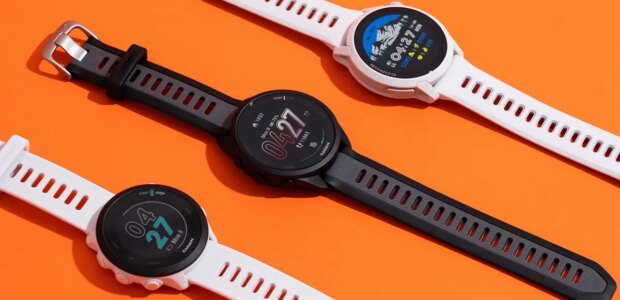

The Amazfit GTS 4 Mini was an intriguing budget option, but after a promising start, it soon faltered. The GTS 4 Mini accurately tracks distance runs, and it advertises a 15-day battery life (in non-GPS mode). But the band feels flimsy, and the clasp is hard to secure. On several runs, when I turned my wrist, the display wouldn’t boot up, which it’s supposed to do.The Apple Watch Ultra has a longer battery life and a larger display than other Apple Watches. It also has an orange “action” button, on the left side of the case, to create shortcuts to specific apps; this button allows you to jump right into a workout, and it’s convenient when you’re wearing gloves. This watch utilizes dual-frequency GPS to gain stronger signals. It’s very accurate, but it’s heavier than other watches. I chose not to test the latest model, the Apple Watch Ultra 2, due to its very large size and starting price.The Coros Apex 2 lacks multiband GPS, unless you splurge for the Apex 2 Pro model, which typically costs $100 more than the Apex 2. The Apex 2 also lacks an AMOLED screen, though it does have some useful advanced features, such as the ability to download maps (a perk for hikers or frequent trail runners on rocky terrains). The Apex 2 advertises 17 days of battery life (45 hours in GPS mode).The Fitbit Versa 4 has a unique design, with a square face that isn’t too heavy. And it tracks steps and distance accurately — as we’ve come to expect from Fitbit. However, the battery life (six days) is short.I was intrigued by the solar-power capabilities of the Garmin Forerunner 955 Solar. In GPS mode, with the assistance of solar charging, this watch claims 49 hours of battery life (the watch reportedly lasts 20 days in non-GPS mode). But I noticed early on that the watch’s touchscreen glitched several times during runs, making it hard to read the face.The Garmin Forerunner 255S (formerly our runner-up pick) has multiband GPS, dependable measurements, simple interfaces, and extensive options for athletes who train both on and off the road. But the Garmin Forerunner 165 offers a similar performance, and it has a better display and an AMOLED touchscreen — typically for about $100 less.The Garmin Forerunner 265 has the same display on our runner-up pick, the Forerunner 165, but with a marginally better advertised battery life. The Forerunner 265 still has some features the 165 does not, including a handy button on the side of the face that allows you to go directly into tracking a run (no scrolling required), plus a training-readiness feature (which the Forerunner 165 lacks). Its GPS signal acquisitions and distance tracking and heart-rate readings are on a par with those of the Forerunner 165.The Garmin Forerunner 570 ($550) and Forerunner 970 ($750) are two high-end watches we did not test because they’re more watch than we think most runners want or need. The Forerunner 570 has an AMOLED screen and features like race prediction, skin temperature tracking, plus a speaker and microphone for phone calls. The Forerunner 970 has those features plus an LED flashlight, and running tolerance and running economy measurements.The Garmin Venu 3 has an AMOLED touchscreen, up to 14 days of claimed battery life, and features for wheelchair users, including push tracking. Its main upgrades over other Garmin watches deal with sleep, including a sleep coach and nap detection. When it comes to running, this model was on a par with the Forerunner 165 and 200-series watches. Unless you’re really focused on sleep tracking, the Forerunner 165, which regularly costs almost $200 less, is just as good for running.The Polar Pacer Pro is targeted at maximizing your training, and it’s equipped with a feature to gauge whether you’re doing productive workouts or overreaching. The scale was somewhat effective, but on occasion I thought it didn’t accurately judge how I felt during a strenuous run. This watch also has breathing tips, which I found to be minimally helpful. The face has an always-on display, which drains the battery (the Pacer Pro lasts seven days on a full charge or 35 hours in GPS mode). Some may prefer that the display is always ready to view during a run. There’s no touchscreen, however, and the charger felt flimsy and not very durable.The Polar Vantage V2 is Polar’s premium sport watch, and it typically costs around $170 more than the Polar Pacer Pro. On one of my first runs with this watch, the pace time froze at 99:59 after 1 mile. And this happened a few times afterward.With the Polar Vantage M3, we didn’t experience any of the freezing screen issues that soured us on the Vantage V2. It has an AMOLED screen, an improved GPS system (dual-frequency/dual-band GPS/GNSS), color offline maps, and route navigation. Those modes worked well during our three months of using the Vantage M3, which we found to be a worthy competitor against our picks. Ultimately, though, our picks were slightly more accurate in tracking distance. The Vantage M3 is a touch heavier than most running watches. It costs about $150 more than our top pick.If you’re a runner looking to compete in ultramarathons or extended long races, the Suunto 9 Baro has a good battery life, and in GPS mode it can last well over 24 hours. However, it doesn’t stand out in terms of tracking distances, heart-rate readings, or in-app use. And compared with newer models, it’s already a bit dated. The band felt flimsy and thin, like a hardened Fruit Roll-Up. But the watch face does fit most 24 mm replacement bands widely available online.The Suunto Race S represents a major upgrade to Suunto’s line of GPS running watches. Almost everything we didn’t like about the 9 Baro performs better in the Race S — most notably distance tracking and heart-rate monitoring. Our readings for both were only slightly off those from our top pick when running known distances and using a heart rate monitor. It has an easy-to-read AMOLED screen that is very intuitive (no double-tapping necessary, as with some models). On the other hand, the charger feels flimsy (it regularly disengaged if we moved the watch while charging it), and this watch regularly costs over $100 more than our top pick.Ingrid Skjong, Amy Roberts, and Thorin Klosowski contributed reporting. This article was edited by Tracy Vence, Kalee Thompson, and Ben Frumin.
Source link