

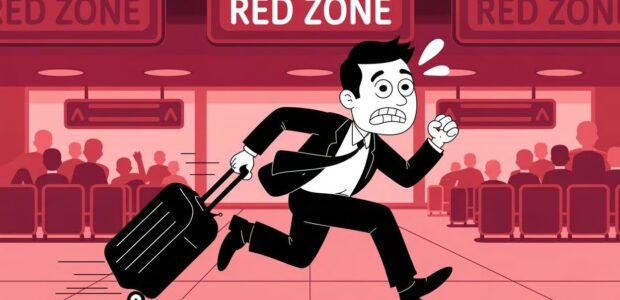

The red zone is that anxious stretch from your front door to your airplane seat, where normal people turn into nervous wrecks.
It’s a blur of high-stakes, time-sensitive decisions that overloads your brain. And it’s so stressful that 73% of couples call travel the ultimate relationship test, according to a 2024 survey from Discover Puerto Rico. It’s even given rise to the “airport divorce” – a trend where couples intentionally separate after security just to avoid an argument.
We’ve all seen it. The passenger screaming at a gate agent over a delay. The family sprinting through the terminal, shoes half-on. The quiet sob at the gate when the flight is canceled.
With air travel booming this summer, the red zone is only getting more intense. But what’s behind this chaos, and is there any way to escape its grasp?
The Science Behind Your Airport Meltdown
The red zone is all about loss of control, according to experts.
“Airports are unpredictable,” said psychotherapist Malaysia Harrell. “Traffic, long security lines, delayed flights. For many, this uncertainty activates the brain’s stress response. Our nervous system begins preparing for a threat rather than travel.”
Your brain can’t tell the difference between a 45-minute TSA line and a tiger that’s about to eat you, explained psychiatrist Ishdeep Narang. And there’s the fear of flying, of course.
“The physiological response – the flood of cortisol, the racing heart – is identical,” he said.
Performance coach Graham Cherrett described this as a “psychological cascade” that often starts subconsciously.
It begins with a core belief, often grounded in past travel nightmares: “This is going to be a disaster.” That belief triggers negative thoughts: “I bet it’s going to be busy,” “I’m going to get stuck in traffic.”
Those thoughts then give rise to physical feelings, including anxiety, a racing heart and shakiness. Your feelings then dictate your actions, like driving erratically, rushing through the terminal, snapping at your family.
Finally, those actions inevitably lead to the same result: you trip, bump into someone, or encounter a simple delay, and … boom. Full red zone meltdown.
Even the Pros Lose It
I should be immune to this. I’ve written about travel for decades, and I know the tricks. I have a passport with pages upon pages of stamps to prove it.
But the red zone doesn’t care.
My pulse quickens the moment I leave for the airport. By the time I reach the terminal, I’m scanning for threats that probably don’t exist: Will the kiosk work? Is that line moving? Did I attach the tag to my checked bag correctly?
It’s a universal affliction. A few days ago in Sydney, I watched a family sprint through security. The father yelled at his wife. The wife snapped at the kids. The kids were crying. By the time they reached their gate, they looked like they’d been through the wringer.
Jon Morgan, a startup consultant and planning expert, said some situations are avoidable. He recalled a man at check-in whose bag was 25 pounds over the limit. The passenger refused to pay the fee, holding up the entire line for 10 minutes to argue about a policy he could have checked online.
“This was a known variable, a predictable risk,” Morgan said. “Because of a deficit in preparation on his part, he became a problem to everyone else. That’s the essence of red zone chaos.”
The Red Zone Survival Guide
Experts say you can make it out of the airport red zone unscathed in a few steps:
Develop a preflight ritual. Angela Betancourt, a communications strategist who flies at least twice monthly with her toddler, says: “I tell myself – and my toddler – that today is a travel day. I literally say it out loud and then take a deep breath, and then I say, ‘Let’s do this!’ It puts me in a game-time mindset.” Other experts swear by deep breathing exercises.
Build in absurdly long buffers. The most experienced travelers give themselves more than plenty of time to get to the airport — that usually means adding at least one hour beyond the required check-in time.
Eliminate micro-decisions. Pack smarter to remove last-minute fumbling. Stephan Blagovisnyy, a frequent traveler who runs a car rental agency, keeps his passport, phone, credit card, meds, and one charging cable in a mini sling that never leaves his body. “If a bag gets gate-checked, the essentials never leave me,” he said.
Accept that you’re no longer in charge. Robyn Sekula, who travels several times per month, has a mantra: “When I enter an airport, I tell myself mentally, ‘You are no longer in charge of what happens now.’ Just take a deep breath and smile.”
These strategies will help you get into the zone before you hit the red zone.
The Bottom Line
Loss of control, high-stakes time pressure, and unpredictable obstacles can hijack your brain in the red zone. Your brain floods with cortisol and adrenaline, and even the smallest frustrations feel huge.
“Most people assume travel stress reflects a lack of discipline or emotional control,” said Ash Bhatt, a psychiatrist specializing in addiction medicine. “In reality, it’s the body’s biology responding to chaos.”
The solution isn’t to become superhuman, but to work with your biology. Calm isn’t found at your destination — it’s cultivated each time you remind your nervous system that you’re not in danger. You’re just in transit.
Christopher Elliott is an author, consumer advocate, and journalist. He founded Elliott Advocacy, a nonprofit organization that helps solve consumer problems. He publishes Elliott Confidential, a travel newsletter, and the Elliott Report, a news site about customer service.