

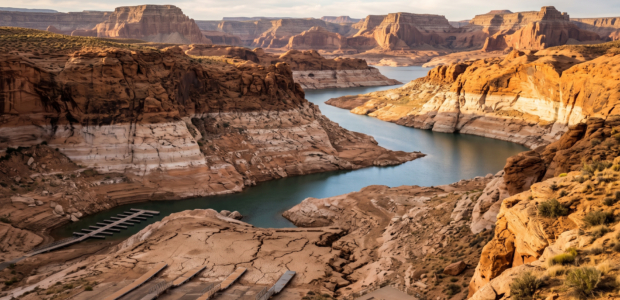

Lake Powell Nears a Historic Low
Cities across the Southwest are stepping up conservation efforts amid the growing crisis facing a key Colorado River reservoir straddling the Utah-Arizona border.
While water costs could rise for Southwest residents, according to experts, it is unlikely that changes in the Colorado River will disrupt the availability of drinking water. Still, cities in Arizona, California and New Mexico aren’t taking any chances. Some are recycling wastewater and limiting when people can water their lawns, while others are desalinating ocean water.
Their efforts come as Lake Powell – a reservoir that produces power for millions of homes across the West ‒ is the emptiest it has ever been this late in the summer. Its water volume has dropped as long-term climate change creates a warmer and drier West.
Lake Powell was 23.4% full on July 19. It was last full in 1983. If its level falls more, that could create environmental catastrophe by stopping the river flowing through the Grand Canyon, a situation known as “dead pool.”
Why the Crisis Could Hit Grocery Bills, Too
The crisis could create ripple effects nationwide. Nearly half of the country’s vegetables and more than three-quarters of its fruits and nuts are grown in California, according to the state’s Food and Agriculture Department. A substantial amount of California crops are irrigated with Colorado River water.
Meanwhile, California and the six other states that collaboratively manage the river have been unable to reach a compromise on what to do about the problem.
“At the end of the day, cities have the responsibility to ensure reliable, safe tap water supplies,” said Kathryn Sorensen, research director for Arizona State University’s Kyl Center for Water Policy. “That’s not the responsibility of the state. It’s not the responsibility of the federal government. And so you see cities really stepping up.”
Some states have been more impacted than others: Farmers and rural towns in Utah are dealing with “unprecedented” water shortages. Most of the water diverted from the Colorado River is used for farming, while 20% is designated for residential purposes.
Sorensen applauded cities for their conservation efforts but cautioned that much more needs to be done by the biggest water users: farmers.
“We can’t solve this problem without the participation of agriculture,” Sorensen said. “The scale is too big to solve it on the backs of cities alone.”
Cities and states could conserve more water by encouraging better landscaping practices and the installation of low-flow showers and toilets, according to Dave Owen, an associate dean for research at the University of California College of Law in San Francisco.
“The reality is there probably is enough water in the Colorado River to go around, if we are smart about how we use that water,” said Owen, who studies water law and environmental policy.
How Four Cities Are Adapting
To understand how they are adapting, USA TODAY spoke to government officials and water policy experts in Phoenix, Tucson, San Diego and Albuquerque, cities that all receive significant amounts of water from the Colorado River.
Phoenix
Phoenix has invested in three water purification facilities, has installed leak sensors at city-owned housing and uses technology that controls irrigation schedules based on weather data. The city, which serves 1.7 million water customers, receives about 47.9 million gallons of water annually from the Colorado River.
“We know that conservation can be incredibly meaningful,” Phoenix Mayor Kate Gallego said.
“We would love to see a collaborative agreement where all users on the river reduce their use,” Gallego said. “The cuts would be much more tolerable if everyone were to come to the table, and we’d like to see the national government understand that from national defense to semiconductors, Central Arizona makes an unusually important contribution, and that needs to be something we consider.”
Tucson
Throughout the late 1900s, Tucson replaced many grass lawns with Sonoran desert landscaping, which includes natural rock formations and native plants that require less water.
Over the past 25 years, these efforts have allowed Tucson to fill a reservoir of water from the Colorado River. Despite substantial population growth, the city uses the same amount of water as it did in the late 1980s, according to Director of Tucson Water John Kmiec.
“We have more than six years of … banking on the ground in the Tucson area that are ready to help buffer any changes or any shortages that may be put on our contract, while they’re trying to work out an agreement on the river,” Kmiec said.
San Diego
For San Diego, which has low yearly rainfall averages, the Colorado River is critical. The city receives about 97.8 million gallons of water from the river, according to Meena Westford, who oversees imported water for the San Diego County Water Authority.
San Diego is also home to the country’s largest desalination plant, which can supply water to up to 400,000 households annually.
On July 14, the federal government struck an agreement with the Metropolitan Water District of Southern California to pay it up to $65 million to stop drawing water from the Colorado River.
The district, which includes San Diego, also has paid farmers to conserve water and leave parts of their land unplanted.
“Conservation is a way of life in San Diego County,” Westford said, “and definitely these new water reuse projects that are coming online should help us manage through some of that drought.”
Albuquerque
In a drought year, about 70% of Albuquerque’s water comes from the Colorado River, according to David Morris, a spokesperson from the Albuquerque Bernalillo County Water Utility Authority.
Albuquerque encourages people to limit watering their plants to three days a week and prohibits watering lawns between 11 a.m. and 7 p.m. Such efforts have helped the city reduce its daily water use from 250 gallons per person in the mid-1990s to about 125 gallons today.
The city has a 100-year water plan dubbed “Water 2120,” which considers different scenarios based on climate change and water shortages. Meanwhile, city officials hope to invest more in aquifer storage, according to Morris.
“We feel like our conservation efforts are succeeding, but we don’t feel like they’re done yet,” Morris said. “We still have a ways to go.”
Reporting by Swasti Singhai, USA TODAY. Originally distributed via USA TODAY Network / Reuters Connect.