

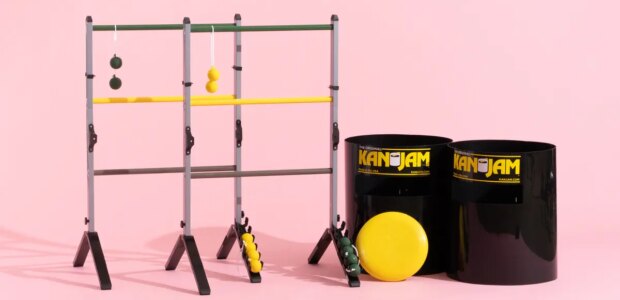

Telling stories by the campfire and luxuriating in the wonder of nature is all well and good, but it doesn’t really get your blood pumping. When you want to move, active games — cornhole being a particularly popular example — are perfect campsite activities. They’re fun for adults, teens, and kids alike, and they provide an excuse to get up and work off the hot dogs without committing to something more strenuous like a hike.To find the best games for this kind of situation, we tested 12 types:I have a lot of experience playing these games at various tailgates, campsites, and picnics. But I wanted to also test with a big group of Wirecutter staffers, so in our original testing we set up ladder toss, Spikeball, Kan Jam, bocce, and washer toss on the courtyard outside our office in Long Island City, New York, and got down to testing.In 2025, I played five new active games (kubb, Mölkky, Helidisc, HeliDrop, and String Trees) to get an idea of how they fared against our current picks and each other.In 2026, we played two more new games: Bottle Bash and Pickle 360. We also tested a few portability focused versions of our pick Kan Jam in Denver and with a group of staffers at our office in New York.Throughout our testing, we discovered the limits of the games and our own abilities. As it turns out, some of these games require a little more hand-eye coordination than others, which tripped up a few of our testers. After a number of washers, bolas, dowels, and frisbees had been thrown and balls had been spiked, we ended up with seven staff favorites.A straightforward yet tricky throwing game: Ladder toss Connie Park/NYT WirecutterTop pickYou can choose from many versions of this popular throwing game, but in our testing, this set provided the best mix of challenge and accessibility for our testers.Ever since humans have had things to throw and targets to throw them at, they’ve made games about being the best thrower of things. From horseshoes to axe-throwing to the rise of the American Cornhole League, these games have become so oversaturated that you’d think they’d be played out by now. That’s why it’s nice to play games that apply the same general principle with just enough variation to keep it interesting.How it’s played: In ladder toss, the target is set up vertically instead of on the ground, like most other throwing games, and you use bolas — two weighted balls tied together with a string. The tricky physics of the bolas can throw even the most seasoned bean bag tossers for a loop, but the general concept is simple enough that anyone can learn in a couple minutes.Ladder toss has several variations of rules and scoring, but the goal is straightforward regardless of which version you play: Land as many bolas on the crossbars as possible to earn more points than your opponents, with the ultimate goal of being first to exactly 21 points.Of the games we tested, this one was easiest for newbies to grasp. This meant that more of our testers felt like they had a chance at winning right off the bat, but more-experienced players were still able to enjoy the challenge of mastering the whirling bolas.The weird physics keeps the game tense and exciting. Since you’re never quite sure how the bolas will react to the ladder — whether they will twist off a rung, wrap around it, or somehow spin right through the rungs without touching any — you’re always surprised by the result of a throw. And no single throwing technique reigns supreme, so every throw has a bit of drama to it, even when everyone knows what they’re doing.It’s well built and portable. The set we tested, the EastPoint Sports Steel Ladderball Set, folds down into flat squares for transport and storage. We liked the solid metal construction and sand-filled bolas. You can find sets made of flimsy PVC, which are a little lighter and might be cheaper, but the step up to a metal or wood set is worth the investment.For Frisbee aficionados: Kan Jam Connie Park/NYT WirecutterTop pickThis team game provides an invigorating mix of exertion and precision. From teens to adults, anyone who can fling a flying disc will have fun.Name a more iconic duo than parks and Frisbees. You can’t. The flying disc is the quintessential toy for aimless outdoor gatherings. But after a few minutes of zipping it back and forth, it starts to lose its charm.That’s why organized disc sports have risen in popularity, and it’s also why Kan Jam is such a good outdoor game. It brings a fun and engaging structure to those disc-tossing skills.How it’s played: Two teams of two set up with a player on each side of the playing field. In between each opposing player, a small plastic cylinder with an opening in the top and a small slot in the front is placed on the ground. The goal of the game is to throw the disc at the can, getting various points if you hit it (one point), drop it into the top (three points), or zip it through the front slot (an instant win).The twist is that your teammate, who stands near the target, is allowed to bat at and redirect the disc as they see fit. Most often, this translates into smacking it down into the top opening for more points.The game encourages a thrilling mix of skill and teamwork. A really good thrower can probably get at least a point each time but will be rewarded with more points if they place the disc in such a way that their partner can slam it home.Kan Jam has a slightly higher skill floor than ladder toss, since at least one team member needs to have basic disc-tossing skills. But since you also have a partner who can make up for bad throws with a bit of athleticism and creative thinking, the Frisbee-challenged can still participate.And whereas ladder toss can be played with a drink safely in hand, Kan Jam is more often played with a drink spilled down the front of your shirt. Still fun, just a little messier.A game of shifting targets: Kubb GoSportsTop pickThis versatile, relatively portable outdoor game can accommodate two to 12 players of all ages.Kubb, also sometimes called Viking chess or the Viking game, has very little to do with chess. It has a king piece that players try to knock down, but that’s where the similarity ends. Instead, it’s an active and engaging throwing game with a constantly changing play space, tricky throwing dynamics, and a devoted following (including some of us here at Wirecutter.)How it’s played: Two teams of players take turns throwing wooden dowels underhand at blocks (called kubbs, pronounced “koobs”) on the other side of the play space. If the first team knocks any over, the other team will throw those back into the field to become targets in the next round. The second team then gets the chance to throw the dowels back at the first team’s kubbs.Play continues this way until one team knocks over all the opposing team’s kubbs (first the ones thrown into the field, then any remaining on the backline) and then the taller king kubb in the center of the play space.Its mechanics are simple but the game remains engaging. Everyone knows how to throw things at a target. But the added wrinkle of strategically placing kubbs back into the field to make it more difficult for the other team makes the game a constant conversation. The game becomes just as much about trying to stymie the other team as it is trying to knock over the kubbs.It shines as a large group game. Kubb is great with two people, but I really enjoy adding team members to the game, making it more dynamic and giving it more of a party atmosphere. I wouldn’t normally recommend more than four people on a team very often, but it can theoretically handle five or six per team.It’s fairly compact and easy to carry. Most versions you’ll find online come with a carrying case, which makes the game fairly easy to bring with you to a park or beach. The regulation size (which we recommend) is a bit hefty at about 20 pounds, but we think the added weight is worth the more substantial pieces and larger kubbs.Forest shuffleboard in the smallest package: StringTrees James Austin/NYT WirecutterTop pickThis straightforward and delightful game packs down into a minuscule package. It’s perfect for people who are looking for a bit of entertainment that doesn’t take up too much room in a pack.In a veritable ocean of games based around throwing one thing at other things, StringTrees is a refreshing change of pace. This simple game brings a version of bar shuffleboard out into nature and packs it into a minuscule package; it’s by far the easiest game to transport out of the ones we tested.How it’s played: Once you find two suitable trees, poles, or other vertical attachment points, you connect the main string between the two. On the string are eight metal rings (four black and four silver). Players take turns sliding the rings down the string in an attempt to have them land in one of three colored scoring zones. Once one player (or team) reaches 21 points, they win (assuming they’re at least two points ahead of the other player or team).This game is refreshingly different. It’s nice to have a simple outdoor game that isn’t based around throwing things. The shuffleboard concept is easy to understand and quick to learn, and though StringTrees lacks the extra horizontal dimension of traditional bar shuffleboard, it’s still a fun game to play.It’s by far the easiest game to bring with you. StringTrees comes in a tiny 8-by-5-inch case and weighs just 7 ounces. It’s small and light enough that you can bring this on a backpack camping trip without really stressing about it, adding a level of versatility that the other games we tested can’t really match.That light weight comes at a cost. This game is our most expensive pick at about $60. That’s a lot of money for a fairly simple game, but if weight or size are important to you, it may be worth the premium.
Source link