

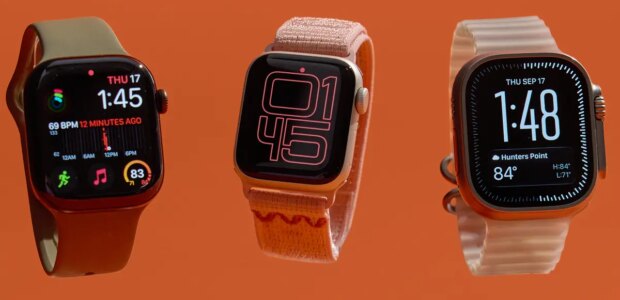

Ruthie Darling/NYT WirecutterUpgrade pickWith a larger, tougher display, longer battery life, and more advanced health-tracking tools, the Series 12 is an upgrade over the SE in a few key ways. But it costs $150 more, and a few of its headline features aren’t available yet.If you’ve been trying to decide between a screenless health-tracking device such as an Oura Ring or a Whoop band and an Apple Watch, note that the new Apple Watch Series 12 is now more competitive with those other trackers. The latest model adds higher-frequency heart-rate tracking and a new Readiness score, Apple’s version of a feature that Oura and Whoop have offered on their devices for years.But while the Series 12 has more advanced health features than previous watches — and combines those with the best battery life of any non-Ultra Apple Watch — many of them aren’t yet available. The same goes for the most interesting (and potentially polarizing) Audio Intelligence features, Live Rewind and Siri Recap, which give you a transcription of the previous 15 seconds of audio you heard and a summary of important conversations, respectively. The features will roll out later this year.But if you’re upgrading from an older Apple Watch, the Series 12’s battery life and lineup of advanced health features alone make it worth buying if you have more to spend.Continuous heart-rate measurements enable more accurate activity tracking. The Series 12 (and the Apple Watch Ultra 4, which has a longer-lasting battery and the same health features) now has the ability to take heart-rate measurements every five seconds. As a result, it more accurately calculates calorie burn from activities that aren’t workouts, such as yard work and house cleaning, toward your Move goal. (And that means you can stop tracking even the smallest activity as a workout. Or maybe that’s just me.) Ruthie Darling/NYT WirecutterMore frequent heart-rate tracking also allows for more frequent heart-rate variability measurements (as often as every five minutes instead of every two hours while you’re resting), and those measurements can tell you how well your body is responding to exercise, stress, and other factors. Recovery heart-rate variability will be used to calculate your Health Age, a feature coming later this year in the iOS Health app. Both recovery and overall HRV metrics will appear in the Vitals app, which will tell you if your health is off or normal.The new Readiness score makes the watch more competitive with Whoop devices. Recovery HRV is also a factor in calculating your Readiness score, which is similar to features on Whoop and Oura trackers. Readiness gives you a score from 0 to 10 assessing how prepared you are for your next workout or training session. To calculate the score, it uses your sleep, activity, heart-rate variability, and other overnight vitals if you wear the watch to bed at night. And, unlike Oura and Whoop, Apple doesn’t lock those insights behind a paid subscription. (Oura lets you see your Readiness score without a subscription, but deeper analysis requires a monthly fee.)The score requires seven nights of sleep to establish your baseline. After a full week of testing, my first Readiness score was a mediocre 6. That translates to Ready: “You’ve been sleeping well lately and all your other metrics are typical. It looks like you’re rested and ready for today,” the watch told me. Unfortunately, my previous night’s sleep wasn’t great after six nights of impressive 90+ scores, so while I may have been “ready,” I also wasn’t feeling my best (hence the 6). Apple says the Readiness score changes throughout the day based on factors like vitals and activity, but mine remained steady (which is fair, because I felt like a 6 all day long).I’ll be testing this feature out more in the coming months alongside the revamped Health app when it launches later this year to see if the insights improve my workouts.It has the same excellent health and fitness features as previous models. Just like last year’s watch, the Apple Watch Series 12 has FDA-cleared health tools such as hypertension alerts, blood-oxygen readings, and an ECG app. But the Series 12 builds on that foundation with its more frequent heart-rate monitoring and heart-rate variability measurements.The most impressive feature is longer battery life. Though Apple redesigned the Series 12’s array of heart-rate sensors to continuously monitor all day long (every five seconds instead of every five minutes), battery life doesn’t take a hit over previous models. In fact, it’s even better. In my testing, the Series 12 lasted 39 hours on a charge, even while tracking 4 miles of outdoor walks and two nights of sleep. And I could’ve eked out some more time with a quick charge (which gives you an extra 12 hours of battery life in 15 minutes) or by enabling Low Power Mode. This is a few hours longer than the Series 11 lasted. Ruthie Darling/NYT WirecutterThe Series 12 also charges up quickly: I placed it on the charger when it was completely dead, and within 10 minutes it was juiced up to 25%. Within 15, it was up to 47%. Apple includes a fast-charging cable in the box, which you should use to get the fastest charging speeds.Charge after 30 minutesCharge after 60 minutesApple Watch SE (2nd gen)33%66%Apple Watch SE (3rd gen)53%96%Apple Watch Series 961%97%Apple Watch Series 1072%100% after 50 minutesApple Watch Series 1182%100% after 50 minutesApple Watch Series 1282%100% after 50 minutesApple Watch Ultra38%71%Apple Watch Ultra 244%75%Apple Watch Ultra 343%73%Apple Watch Ultra 453%83%The new bronze aluminum finish is beautiful. The Series 12 comes in four colors: Light Gold, Black, Space Gray, and Dark Bronze. I tested the bronze model, which isn’t as flashy as the pink (sorry — Rose Gold), red, or blue finishes of previous watch lineups but is really elegant in person. Apple also brought back the ceramic finish in a glossy Pearl White and Night Blue. Ruthie Darling/NYT WirecutterFlaws but not dealbreakersThe health features are all over the place. Between the Readiness and Vitals apps, the Heart Rate app, and the main iPhone Health and Fitness apps, your Apple Watch metrics are synthesized and analyzed in ways that can be kind of confusing. You have to remember to check your Readiness score, which can change throughout the day, as well as your Vitals app, which analyzes your daytime vitals and nighttime ones, to tell you if your health status is “notably off,” “slightly off,” “typical,” or “favorable.” (My health status: typical. I’ll take it.) It uses the more frequent heart-rate variability measurement to calculate this. Overnight heart-rate variability in the Vitals app is used to determine if your health is trending in the right direction. Caitlin McGarry/NYT WirecutterThen there’s the Health app on your iPhone, which is getting a redesign later this year that will offer even more analysis, such as a new Longevity tab, where you’ll see your Health Age. It’s unclear if the Health app will display all of these various scores and insights in ways that are, well, clear (or actionable), but it’s a lot to keep track of (and obsess over).The Audio Intelligence features aren’t ready yet. The Live Recap and Siri Rewind features that sparked some conversation about the Apple Watch’s ability to overhear what people are saying aren’t available to try yet. Considering that Apple highlighted these features (enabled by the new S11 chip) as one of the Series 12’s selling points, this watch is not worth buying for those features just yet.
Source link