

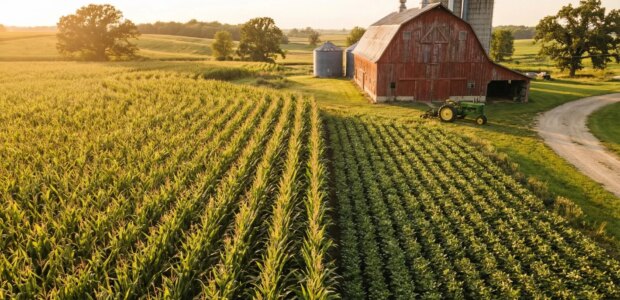

On Erica and Eric Sawatzke’s Minnesota farm, the math of farming has grown increasingly unforgiving. Even with strong yields, the numbers often don’t add up. A new round of federal aid announced in late 2025, while welcome, underscores how far the gap has grown between what it costs to produce crops and what farmers earn selling them. To help them do better financial planning, they turn to expert advice, online tools and loan programs.
The Sawatzkes raise turkeys, corn and soybeans on 500 acres of land that has been in Erica’s family since 1866. Erica is a sixth-generation farmer who returned home after working in agricultural advocacy, determined to keep the operation viable. Her husband, Eric, a full-time high-school agriculture teacher who farms alongside her, says “I don’t think I’ll be able to completely leave the classroom. We need the health insurance, and we need the steady income to help support the farm operations.”
They seek advice from Deron Erickson, a farm business management instructor and advisor who also farms corn and soybeans. “Probably 75% of my (clients) have outside income to help subsidize the farm,” he says.
Erickson, who is also president of the National Farm and Ranch Business Management Education Association, encourages farmers to start with an annual financial review conducted with an outside expert and to use benchmarking tools to identify risks early.
Practical tools he recommends include the USDA’s farmers.gov portal. It is a starting place for information on loans, disaster assistance and federal payments, along with the Farm Service Agency, which administers operating, ownership and emergency loan programs. Its website has a search tool that helps farmers locate a USDA service center within one’s state and county where farmers can learn more about loan programs based on funds appropriated by Congress through the Farm Bill or ad hoc programs.
‘Stopgap, Not a Solution’
In December, the U.S. Department of Agriculture made $12 billion available in one-time bridge payments to offset losses tied to trade disruptions and rising costs.
The Sawatzkes qualify, but the numbers illustrate why many farmers view the payments as a stopgap, not a solution. The USDA projected total farm production expenses in 2025 to be $467 billion, with farmers expected to lose $34 billion. Last year, the Sawatzkes estimated that soybean income on their farm fell roughly $75 to $85 per acre below the cost of production. Under the bridge program, soybean growers like the Sawatzkes will receive $30.88 per acre.
“It helps,” Eric Sawatzke says. “But it’s a small bandage on a much larger deficit.” In addition to a drop in international trade and having “too much grain,” he says equipment purchases and repair costs add up.
“The cost of repairing parts on the corn head is higher than the value of the whole thing,” he says about their older combine. “Access to more affordable parts and supplies would do far more than a one-time bridge payment in the long run.”
Farmers Increasingly Rely on Credit
Nationally, farmers are increasingly relying on credit to manage expenses, which include parts, labor, land rent, fertilizer, chemicals, seed and taxes.
According to the American Bankers Association, U.S. banks and farm lenders held roughly $205 billion in outstanding farm loans in 2024, accounting for nearly 38% of total farm lending nationwide.
American Farm Bureau Federation President Zippy Duvall, a Georgia-based beef and poultry farmer, says that while federal aid and loans help stabilize operations, it does not erase structural challenges. His organization has information on financial literacy, grants and scholarships.
According to Bailey Corwine, communications manager for Farm Bureau, financial strain often overlaps with mental health challenges and she recommends the farmers seek support through its Farm State of Mind resource.
Resources for Struggling Farmers
The National Farmers Union also offers business planning resources and financial education, such as a farm business toolbox that helps farmers assess the health of their business. It also has a free 10-week educational program for beginning farmers.
That section of its website has a directory that connects farmers to counseling and peer-support resources nationwide. Without such help, Erickson says, it’s easy for stress to compound quietly.
“If you’re just sitting alone at the kitchen table looking at red ink, you can freak yourself out pretty fast.”
On Sawatzke farm, they are not giving up because the goal is about preserving a legacy and serving America.
“We’re growing food to feed people,” Erica Sawatzke says. “That responsibility and that pride is why we keep going.”
This article originally appeared on USA TODAY: Farmers face financial strain, federal aid a ‘small bandage’
Reporting by Sheree R. Curry / USA TODAY
USA TODAY Network via Reuters Connect