

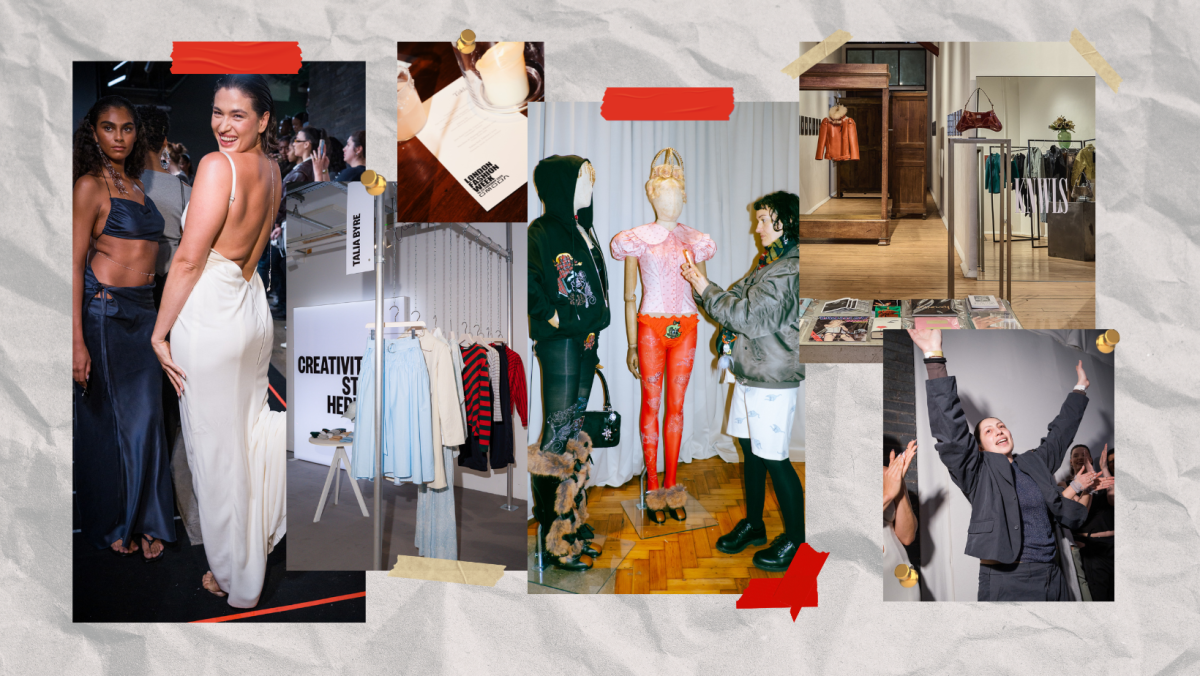

A cool crowd sipping natural wine spilled onto the street outside Perfect Lives bookstore in Hackney on the first day of the Fall 2026 shows at London Fashion Week. It wasn’t a fashion show that brought them there, but Talia Byre’s annual zine launch. Ahead of her bridal collection unveiling in March, the rising star hosted a party to celebrate a zine that features contributors like Dev Hynes and Deborah Levy.Byre, known for a modern-day take on the working-girl wardrobe for women who can debate Proust or Pink Pantheress, isn’t abandoning the runway. She’ll be back in September; but in the meantime, she’s carving out space to rewrite the rules of fashion week and playing to her own agenda.
Photos: Courtesy of Knwls
Nearby, Knwls presented its Fall 2026 collection in a concept store format, followed by a yoga class the next morning. The new collection — merino sweaters with contrast mohair v-stripes, varsity bombers in spongey bouclé knits and cropped, gigot-sleeved jackets in neoprene-bonded lambskin — appeared alongside a curation of Spring 2026 which was available to guests for purchase. As a follow-up to last season’s decampment to Milan, this format allowed Charlotte Knowles and Alexandre Arsenault to reconnect with their community and create a moment that lasted longer than 10 minutes. The look and feel of London Fashion Week was more dynamic than ever this February. The event expanded to five days, while the New York and Milan schedules feel truncated. The week was bookended by sterling efforts from Tolu Coker (with a guest appearance from none other than King Charles III) and Daniel Lee’s latest for Burberry. Throughout the course of the event, there were stellar outings from Erdem and Simone Rocha. However, when it comes to format, designers are thinking outside the box and suiting themselves.
Jonathan Anderson, Anna Wintour and Lesley Manville at the JW Anderson Pimlico Road store openingPhoto: Hoda Davaine/Getty Images
Forefather of the new establishment JW Anderson opted out of a show again this season, instead celebrating the opening of the brand’s Pimlico Road store. Steve O Smith held a luncheon at the Mandarin Oriental, while Roksanda invited guests to dinner at Claridge’s. 16Arlington brought guests to its studio for private appointments and Nicholas Daley opened a pop-up store for the weekend. Aaron Esh launched his footwear collaboration with Katy England and Zara at Dover Street Market. There was nothing conventional about it. Many of the city’s eminent talents were anywhere but the runway.But it’s not just the format that’s in flux. London’s starriest newcomers are also rethinking how they do business: Byre is mostly working with a direct-to-consumer distribution with a handful of wholesale accounts. Steve O Smith, the recipient of the LVMH Prize’s Karl Lagerfeld Prize (who designed a dress for Emma Stone in Yorgos Lanthimos’ Super Bowl commercial), operates on a made-to-order model.
Photos: Courtesy of the BFC
“It’s our job to create flexible formats to showcase exceptional work and visions in environments that reflect open, transparent formats for the industry. So I’m really proud that it’s not just shows,” Laura Weir, British Fashion Council CEO said in an address at an opening breakfast event. “There are events and retail openings and moments of commercial excellence and creative excellence, too.” Almost one year into her position as CEO at the BFC, Weir is on a mission to restore LFW to its pre-pandemic glory, and things are growing: The International Guest Programme, which brings in press and buyers from outside the UK, had more participants this season than in September. And compared to last February, the number of designer and brand participants rose 11% to a total of 90. Overall, the schedule included approximately 41 runway shows, 20 presentations, four appointment-based formats, 33 events and 19 digital activations.The new energy is most palpable in the collections of emerging talents who have long been viewed as the lifeblood of London’s fashion scene.
Photos: Cris Fragkou/Courtesy of the BFC
Chopova Lowena’s preternatural cool unfurled in a packed presentation at the Crafts Council Gallery on Saturday afternoon. Showing a runway once a year in September, the design duo considered a presentation as an opportunity to underscore “a message of community and togetherness.” The brand’s contemporary take on the Regency era, with kitschy nods to golfing culture, was best observed up close to fully appreciate the upcycling efforts and nods to 19th-century dress.
Patrick McDowell Fall 2026Photo: Launchmetrics Spotlight
Then there were the designers whose show formats were on the traditional side, but whose ideas are decidedly nontraditional in the wider fashion context. Patrick McDowell’s gambit is sustainability, with his efforts earning the brand the Queen Elizabeth II Prize in 2025. He isn’t interested in mass production, with each garment manufactured in limited quantities or made-to-order in London, and available direct-to-consumer from the brand’s website. Furthermore, every piece in the Fall 2026 collection is fully traceable through a Digital Product Passport (DPP), offering transparency into its provenance, makers and journey. “I think the wider consciousness has really shifted, the consumer now asks for [sustainability] and is aware of it. It’s changed massively since I started,” McDowell said.Sustainability is nothing without substance, and the collection had it in spades, proposing the brand’s most mature offering yet. Inspired by the pervasive balletic influences in the oeuvre of American photographer George Platt Lynes, McDowell translated the evocative work into an elegant display of mostly eveningwear.
Karoline Vitto Fall 2026Photo: Launchmetrics Spotlight
Karoline Vitto’s Saturday morning show was in stark contrast to most runways, not only in London, but across all fashion capitals. The Brazilian designer, who shows once a year on the London schedule, is committed to uplifting size inclusivity. Inspired by ’90s and ’00s silhouettes — without the heroin chic body ideals — the collection is “celebrating curves without demonizing them,” per the show notes.To help realize her inclusive vision, Vitto designed a collaboration for Pull & Bear, the principal sponsor of the BFC’s Newgen program. For any young designer, a high-street partnership can inject their business with the kind of cash flow it takes to host a runway and then some. For her part, Vitto lended Pull & Bear her design handwriting while also extending its size range, with her capsule going up to a 2XL. Vitto has been working from the Paul Smith’s Foundation studios, which also supports designers like Masha Popova, Petra Fagerstrom and Renata Brenha. “This opportunity has allowed me to grow the business and direct budget towards sampling and development, and the mentorship has made it possible to spend more time nurturing the business side of the brand,” Vitto said.
Photo: Courtesy of Karoline Vitto
“To me, London Fashion Week has a distinct identity and drives its own trends, with each show presenting a unique vision and statement,” said Brigitte Chartrand, Net-a-Porter’s Chief Buying and Merchandising Officer. Net-a-Porter buys collections from Clio Peppiatt, Tove and Liberowe, who either don’t show on the fashion calendar, show once a year or have shown for the first time. “The city continues to be known for its expanding group of young, emerging talent and London designers are defined by their creativity and a strong design identity,” she added. A decade since Brexit, and a number of years after the pandemic and the demise of Matchesfashion.com — which had an adverse effect on many London brands — British fashion is recalibrating for its next chapter. Alongside mainstays like Burberry, Erdem and Simone Rocha, platforms like Lulu Kennedy’s Fashion East are going strong 20 years since their inception, and institutions such as Central Saint Martins and the London College of Fashion continue to incubate fresh talent. At Friday’s opening event, Weir reassured guests that the British Fashion Council is there to “promote, defend and support” designers.
Laura Weir, King Charles III and Stella McCartney front row at Tolu Coker Fall 2026Photo: Hoda Davaine/Getty Images
“Progress [to me] is substantial investment in growing the infrastructures that allow emerging brands to sustain themselves,” says Vitto. “That means affordable studio space, access to specialized mentors and peer support.”The next generation of talent is representative of a post-pandemic era, having already been forced to rewrite the “rules” around how fashion designers are supposed to operate. With creativity still under threat from macroeconomic headwinds, London’s designers are adapting. In the new fashion order, they have the liberty of selecting the model most appropriate to their mission.”London has really allowed me to grow as an emerging brand and the support I received has been key,” Vitto said.Regardless of how designers choose to operate their business, however, McDowell asserts that some things never really change: “Above all, the pieces have to be beautiful and clients must want to wear them; otherwise what’s the point?”Fashionista is the leading online destination for current and aspiring fashion and beauty industry professionals. Reach businesses, students and consumers alike with our range of digital offerings.
Source link