


Put delicately, 2025 was a challenging year for the global supply chain. Donald Trump’s sweeping tariffs sent manufacturing skyrocketing and strained many of the very same U.S. businesses he claimed to be helping. Now more than ever, beauty brands — especially independent and emerging ones — are navigating largely uncharted territory by trying to stay ahead of the industry’s fast-moving trends all while facing tariffs, supply chain disruptions and global economic uncertainty.Enter Australian manufacturing platform Atelier’s newest innovation: Platform01, a chat-based interface that functions as “a coordination engine for physical manufacturing resources around the world,” Nick Benson, Atelier’s CEO and co-founder, tells Fashionista. Currently attuned to the beauty industry’s supply chain, Platform01 taps into Atelier’s expansive database of more than 8.5 million supply chain combinations to give beauty brands the tools to orchestrate their manufacturing from product ideation to delivery.
Nick Benson, Atelier CEO and co-founderPhoto: Courtesy of Atelier
Think of it as a one-stop shop for a beauty brand’s product development cycle. As Benson explains, Platform01 is “a procurement team, a supply chain team, a regs [regulation and compliance] team, an R&D team and a consumer panel all in a single product, all backed by global supply chain data.”A systems and experience designer by trade, Benson quickly noticed that navigating the supply chain was quite the pain point for brands. “I found that [with] the work that I was doing, the most valuable work wasn’t in the ideation of the product, it was in the orchestration of the supply chain to create the product,” he says. “The idea is only as good as your ability to operationalize it, and that was really hard.” Benson later established his own consulting firm, where he was routinely approached to help with product development and manufacturing (never marketing or fundraising, he notes). So he set out to create a “scalable solution” to supply chain challenges using cloud manufacturing, thus leading to the beginning of Platform01.For a typical consumer packaged goods (CPG) business, product development could take upwards of 18-to-20 months just to present a product to a consumer panel, but Platform01 compresses the cycle to three-to-six months. Within Platform01’s chat-based format, beauty brands can research the product they want to create, then consult a generative AI-powered agent, or “guardian,” to suggest formulations.
Photo: Courtesy of Atelier
Of course, it’s not merely spitting out any old formula — Platform01 absorbs the brand’s context, product strategy, formulation guidelines, target market, competitors and more to present distinct, efficacious formulas. After all, not all supply chains are created equal. For example, CVS’ supply chain wouldn’t be relevant to Chanel, and vice versa.”We carve out a subset of our Knowledge Graph of our database that is relevant only to that brand,” Benson shares. “The brand gets a very specific, fully tailored proprietary set of manufacturers [in the] global supply chain to deploy.”Not only are the ingredients cross-referenced to target the problem the beauty brand is addressing, but they are also screened for availability to ensure the brand can actually develop the desired product. After narrowing down a formula, brands can consult a built-in synthetic consumer panel composed of AI agents who can “test” a formula in real time. As Benson points out, the tech industry regularly releases unfinished products to beta groups, but beauty brands will never adopt the same strategy. “What a synthetic consumer panel allows you to do is test with your customers without having to actually put anything out into the world or anything on the line,” he adds.
Platform01’s synthetic consumer panel share their thoughts on possible product formulas.Photo: Courtesy of Atelier
Say the consumer panel doesn’t like the sound of the formulation, then it’s back to the drawing board, without sacrificing the brand’s image (or a real consumer’s skin). But if the panel approves the formula, brands can then test for commercial viability to see if consumers would actually buy the product in the first place. Platform01 also puts tariff implications front and center, as it allows brands to reduce their tariff exposure by specifically targeting low-tariff regions.”This is a really hard thing for existing procurement teams to do right now,” Benson notes. “They have a very limited set of manufacturers that they’ve worked with for a long time.”
Platform01 can specifically target lower-tariffed regions for packaging.Photo: Courtesy of Atelier
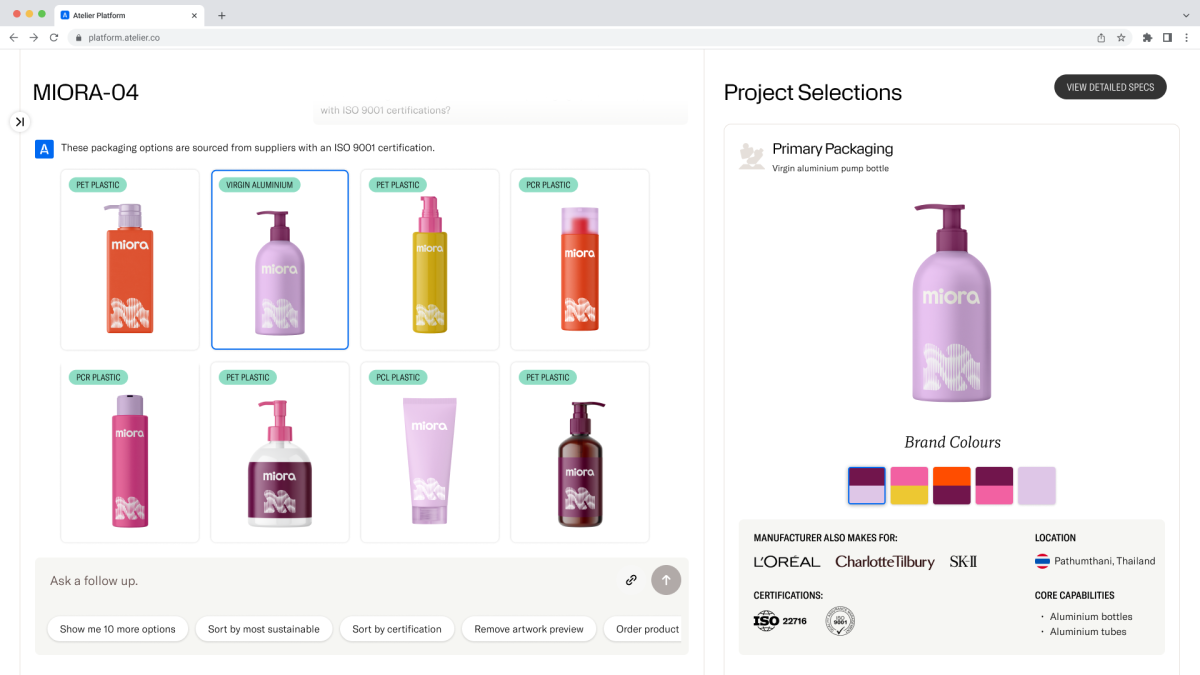
In addition to workshopping formulas, beauty brands can see a 3D model of their product using a one-to-one digital representation of actual packaging available at the selected manufacturers. Platform01 lists each manufacturer’s notable certifications as well as the industry partners they work with, such as heavy hitters like Lancôme, Clinique and Nars. Users can even transfer a to-scale rendering of their product to their phone to see how it would look on a shelf or next to their existing line.The best part? Once all these steps are completed, beauty brands can have samples in their hands within two weeks. “We’re able to put all of that power in the hands of the marketer so that they can then test quickly, bring products to market fast and be in control of their own destiny,” Benson says.
Beauty brands can customize their packaging and test it out with Platform01’s synthetic consumer panel.Photo: Courtesy of Atelier
Currently, there’s no cost to use Platform01 until the beauty brand buys the units they created, essentially treating Platform01 as a manufacturer. Many top-performing beauty brands are among its users, including Revlon, grooming brand Harry’s and holistic skin-care brand Weleda, and it’s continuing to expand its user base.”Generally, when you launch new tech, education is expensive and it takes time and there’s often resistance, but brands are feeling the burn of this problem so deeply that we’ve seen pretty great adoption,” Benson notes.Looking ahead for Platform01, growth is on Benson’s mind, and that means targeting brands of all sizes. “We want to work with, not just the big guys, but we also want to work with the up-and-comers as well and help them get up and challenge those big brands and move fast,” he says. “Fundamentally, we help them change the economic profile of their brands so they can spend more on growth.” Beyond beauty, Platform01’s long-term goal is to “move through verticals” by expanding into accessories, eyewear and more.Benson predicts 2026 won’t be much smoother than 2025 when it comes to supply chain hiccups. “We should assume that instability is the new norm,” he notes. “The best thing to do to combat instability is have a flexible and dynamic response to it.” Platform01’s inherently “anti-fragile” approach aims to do just that..Fashionista’s audience includes 1 million site visitors, 110,000 newsletter subscribers and 4.74 million social media followers. Want to know how to reach them? Learn more.
Source link