


Listen to the article
4 min
This audio is auto-generated. Please let us know if you have feedback.
The Supreme Court on Friday ruled against President Donald Trump’s use of an emergency powers statute to impose open-ended tariffs, marking a major legal setback for the president’s trade policy.
In a 6-3 decision, the court rejected Trump’s claim that the 1977 International Emergency Economic Powers Act gave him the authority to impose broad tariffs globally, saying that Congress alone has the power to lay and collect tariffs.
“The Framers [of the Constitution] recognized the unique importance of this taxing power — a power which ‘very clear[ly]’ includes the power to impose tariffs,” the ruling says.
The opinion, written by Chief Justice John Roberts, found that Congress’ taxing power cannot be handed off through vague language, rejecting the administration’s argument that the words “regulate” and “importation” in IEEPA gave the president broad powers to impose tariffs.
“Recognizing the taxing power’s unique importance, and having just fought a revolution motivated in large part by ‘taxation without representation,’ the Framers gave Congress ‘alone . . . access to the pockets of the people,’” the ruling says.
The opinion rejected the administration’s argument that the president’s declaration of a national emergency was sufficient to unlock extraordinary tariff power that could only be restrained by a “veto-proof majority in Congress.”
“That view, if credited, would ‘represent a ‘transformative expansion’ of the President’s authority over tariff policy,” the ruling says.
Because Congress has the “power of the purse,” any transfer of broad, discretionary tariff-setting would require clear, specific statutory language, not general or ambiguous terms.
“When Congress has delegated its tariff powers, it has done so in explicit terms and subject to strict limits,” the ruling says.
The National Retail Federation said Friday’s ruling on tariffs “provides much-needed certainty for U.S. businesses and manufacturers, enabling global supply chains to operate without ambiguity.”
“Clear and consistent trade policy is essential for economic growth, creating jobs and opportunities for American families,” NRF Executive Vice President of Government Relations David French said in a statement. “We urge the lower court to ensure a seamless process to refund the tariffs to U.S. importers. The refunds will serve as an economic boost and allow companies to reinvest in their operations, their employees and their customers.”
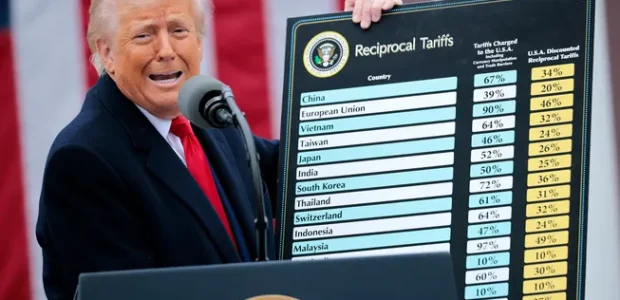
The Trump administration appealed to the high court last fall after two lower courts ruled the president exceeded his power by bypassing Congress’ constitutional authority to set tariffs earlier in the year, including so-called reciprocal tariffs. The president argued the levies were justified to address a national emergency caused by the U.S. trade deficits and fentanyl trafficking from Canada, China and Mexico.
The administration urged the court to move quickly, arguing that legal uncertainty over the tariffs was hurting trade negotiations. The Supreme Court agreed to expedite its review and consolidated three separate lawsuits challenging tariffs that Trump announced in April and later finalized in August. The plaintiffs in the suits included seven businesses and 12 states.
Despite Friday’s ruling, the Trump administration has codified numerous other tariffs using statutes with more historical precedent for setting levies. These include a slew of sector-specific duties on goods such as steel, cars and furniture implemented under Section 232 of the Trade Expansion Act of 1962. Trump also has additional tools at his disposal to continue implementing duties, albeit with less broad reach than his use of IEEPA.