

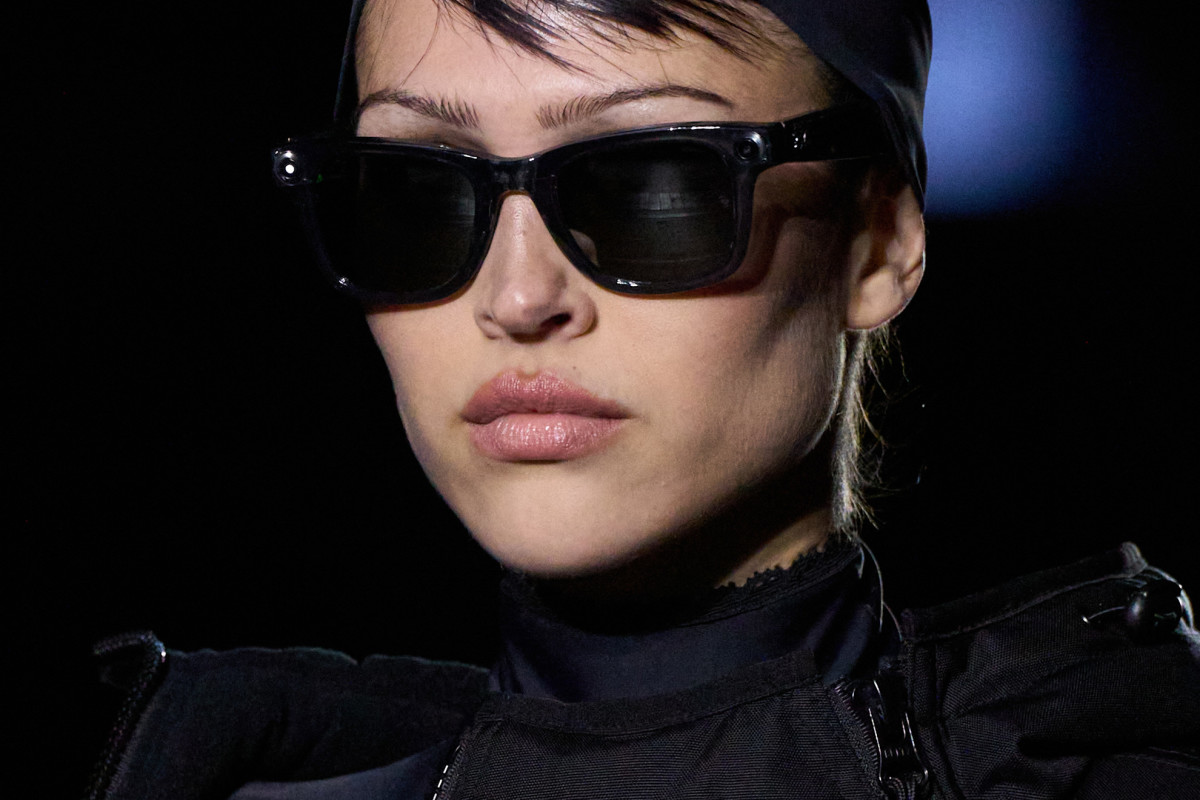

Over the last few years, there’s been a shift in how we use technology. What was once relegated to our desks and hands is now wearable — and the commercial success of Meta Ray-Ban AI glasses, Oura Rings and Apple Watches proves that people are ready to embrace this. At least, certain people are, especially biohackers, fitness enthusiasts and productivity optimizers. Despite this, they remain conspicuously unfashionable, even as collaborations are trotted out to convince people otherwise.The Fashion-Tech Collabs ContinueAfter slowing down quite a bit post-2010s, fashion-tech collaborations are in the news again. At Paris Fashion Week last March, Coperni unveiled its Meta Ray-Ban collaboration (see above), though the cultural response was negligible. Hermès continues to release new Apple Watches, which did nothing to change the fact that the device is an outfit-ruining eyesore, no matter which logo you stamp on it.More recently, Ultrahuman tapped Glenn Martens for a smart ring collaboration with Diesel. Samuel Ross of SR_A Studio joined Whoop for an upcoming capsule collection of customized bands. During the Super Bowl, two ads rolled out Oakley’s Meta smart glasses. And at this past New York Fashion Week, Jane Wade incorporated branded nasal dilators by Intake Breathing into its Fall 2026 show.Over the last few years, the rhetoric that’s being shoved down our throats is that fashion and tech are on the precipice of blending and integrating in unimaginable ways. But when you look at style icons, it girls and influencers, how many are earnestly rocking tech pieces as fashion-forward must-have accessories?
Very few Fashion Week street style images feature Apple Watches, but we found two (from within the last three years).Photos: Jeremy Moeller, Valentina Frugiuele/Getty Images
Who is wearing wearable tech?Tech companies can point to impressive sales figures and market growth projections to denote the success of their wearables. According to McKinsey and Business of Fashion, wearables are the fastest-growing type of accessory, expected to grow 9% annually through 2028 and exceed $30 billion by 2030.The holiday gifting season was especially big for the category: Online sales of smart watches increased 285% year over year according to Adobe, which specifically listed the Apple Watch Series 11, Ray-Ban Meta Glasses and Oura Ring among the season’s “hot sellers.” Oura, which recently announced an $11 billion valuation, has sold 5.5 million rings (half of those in the last 12 months alone) and reached $1 billion in revenue for 2025. EssilorLuxottica said it more than tripled its Meta AI glasses sales in 2025, selling more than 7 million units. In Q2 of last year, Apple Watch revenue exceeded $100 billion.Still, fashion relies on less quantifiable factors like desire, aspiration and style-consciousness. When you measure wearable tech by these qualitative standards, it’s failing. “The root problem is that fashion and tech have been building in silos and aren’t creating within the intersection of fashion, tech and wearables,” Janey Park explains. Park is a fashion tech strategist and industry analyst who has worked with LVMH, Elizabeth Arden and Nordstrom. She thinks the rejection of tech wearables in fashion is about a lack of synergy, with tech prioritizing utility and fashion favoring expression and beauty. “Mass adoption cannot be forced and fashion’s it girls would never wear gadgets just because the technology is useful. If it’s not chic, aesthetic or culturally coveted, then wearable tech will fail.” Apple Watches, Meta Glasses and Oura Rings all signal a corporate geekiness that is antithetical to fashion. Many have tried to adjust this. Apple Watch bands come in countless styles and colors and yet nothing transmutes the smartwatch into a coveted bracelet. While Oura’s new colorful ceramic rings, or the emergence of third-party covers (like offerings from Stef Eleoff) might help solve aesthetic issues, they don’t address deeper ones.
Doja Cat and Teyana Taylor star in 2025 holiday campaign for Ray-Ban Meta glassesPhotos: Courtesy of Ray-Ban Meta
AI, MAHA and Other PR ChallengesTech wearables haven’t just failed to become desirable, they’ve made desirable items uncool. Meta Glasses rely on the iconic shape and edginess of the Wayfarer, once a celebrity-favorite style; but now, the silhouette feels tainted by (or even associated with) bad behavior as more stories come out about women being secretly filmed and harassed.Meanwhile, Oura’s alignment with the Trump administration and partnerships with the Department of Defense and Palantir raise major privacy concerns (despite the CEO reassuring users their data is safe). In 2025, U.S. Health Secretary Robert F. Kennedy Jr. revealed that he envisions “every American is wearing a wearable within four years,” as part of his MAHA (make America healthy again) agenda. In June, Health and Human Services solicited applications for contractors to design a multimillion-dollar marketing campaign that will include “populariz[ing] technology like wearables as cool, modern tools for measuring diet impact and taking control of your health.”The link between tech and the government isn’t the only issue. “Right now, technology and AI are broadly targeted as the enemy by many consumers,” Park shares. “Layoffs, data misuse and growing distrust have shaped how people emotionally respond to new tech and innovation.”
Oura Ring appPhoto: Courtesy of Oura
Not to mention that consumers are exhausted. In a survey from eMarketer, 81% of Gen-Z respondents and 78% of Millennials “wish[ed] they could disconnect from digital devices more easily.””Over the past two decades, people have had to learn (or have refused to learn) the internet, social media, ecommerce, apps, blockchain and of course AI. Now we are asking them to understand embedded technology inside the things they wear,” Park adds. What’s clear is that there is an ideological clash that the government and tech conglomerates aren’t clocking. When sartorial circles accept something as cool it’s often unique and rebellious, while touting freedom, joy and self expression, all of which is incongruous with tech wearables in their current form.
New Oakley x Meta campaign for 2026Photo: Courtesy of Oakley and Meta
“We’re in a time where autonomy and self-definition are especially important,” New York designer, Talia Abbe tells me. “People are more cautious about anything that feels prescriptive or observational instead of empowering.” Bridal designer Harleen Kaur echoes these sentiments. “For me, fashion is emotional, cultural and aesthetic. The tech wearables I’ve seen have been more focused on function and optimization.”However, in the opinion of fashion-tech writer Emma Rayder, optimization isn’t inherent problem, rather its framing. “Clothing and accessories are sold as items for self-optimization: these heels will make your legs look miles long; this coat will make you look put together enough to get the job and the guy. Tech companies should pay attention to luxury’s marketing tactics. Wearables shouldn’t be sold as something you need, but as something you want because wearing it will make you a better version of yourself.” Aspiration is lacking, but so is the emotional connection. “Demand is emotional and aesthetic as much as it is functional and we’ve yet to see many fashion applications that hit both of those notes convincingly,” fashion technology expert, Jessica Veronica Couch explains. “That means bringing in stylists, art directors and cultural strategists early in the development process, not as an afterthought.”
Google co-founder Sergey Brin with Diane Von Furstenberg wearing her Google Glass collaboration on the NYFW runway in 2012Photo: Frazer Harrison/Getty Images for Mercedes-Benz
Learning From Past FailuresThe solutions feel like common sense, and yet, fashion tech wearables have a proven history of failing. When Google Glass launched in 2013 for $1,500 with an accompanying short film directed by FKA Twigs, it flopped so spectacularly that there was even a portmanteau coined to describe people who wore them: Glassholes. Teaming up with Diane von Furstenberg didn’t save it. Neither did Google’s Jacquard smart fabric project with Levi’s.Google wasn’t alone. In 2014, Opening Ceremony (R.I.P.) teamed up with Intel to create MICA (My Intelligent Communication Accessory), a $495 smart bracelet. It was discontinued in 2017, which is also when Intel axed its broader health wearables division. Also in 2014, Tory Burch teamed up with FitBit to make the fitness tracker more stylish; the line would later be abandoned. Smart watch company Ringly launched in 2014 only to shut down operations in 2018. Also around that time, Canadian tech company North launched the brand Focals as a more stylish alternative to the smart glasses that had existed on the market; Google acquired the company in 2020 and ceased manufacturing the eyewear.Despite its past failures, Google is trying again.”There were so so many lessons learned,” reflects Isabelle Olsson, head of industrial design for Google’s Home and Wearable products. In 2025, the tech conglomerate announced a $150 million deal to create smart glasses with Kering Eyewear (which owns Gucci, Saint Laurent, Balenciaga, etc.), American eyewear chain Warby Parker and experimental, fashion-forward South Korean luxury brand Gentle Monster. On paper, it’s an effective strategy: partnering with brands fashionable customers already trust. “I think for people to be able to adapt to new things, there has to be something familiar about it,” Olsson adds.
Photo: Courtesy of Diesel
Launchmetrics Spotlight
The ‘Digital Detox’ ProblemBut can familiarity solve wearable tech’s numerous problems? As we come into a tech wearable renaissance of sorts, especially on the precipice of Google’s potential hat trick, there is a growing movement where it’s cooler to be offline, analog and untraceable. Multiple studies cite that digital fatigue is negatively affecting productivity, accuracy, mental health, job satisfaction and personal-and-professional boundaries. According to Deloitte, 41% of consumers dislike managing their devices, and adults ages 18-40 feel more overwhelmed (37%) than older generations (23%).For Vogue, Sonja Knežević declared that “The return to the analog world is officially one of 2026’s biggest trends.” More people are going “chronically offline,” taking up tactile hobbies, using digital cameras, and joining phone-free events while others are more hardcore, swapping their iPhones for flip phones. Searches for “digital detox ideas” and “digital detox vision boards” are up by 72% and 273% respectively, according to the 2025 Pinterest Summer Trend Report. It brings to mind a tweet from Noah Smith that went viral in 2017:15 years ago, the internet was an escape from the real world. Now, the real world is an escape from the internet.— Noah Smith 🐇🇺🇸🇺🇦🇹🇼 (@Noahpinion) August 28, 2017
In lieu of tech wearables, some designers have focused on analog accessories. Diesel just released wired earbuds (above, left) that look more like a bag charm than tech. On the runway, Coperni nodded to analog nostalgia with its Tamagotchi bag charm (above, right) and CD player Swipe Bag; however, neither were released for sale. This rejection of modernity and embracing of analog systems continues as more become tired with tech billionaires, surveillance and algorithmic nudging. It’s not cool or rebellious to wear an Apple Watch, but it is to buy a vintage analog one. So where does that leave this burgeoning sector of tech wearables?The solution is the same no matter who you ask: Seamlessness is king. Experimental L.A. designer Tommy Bogo, recently released the PocketCam — an all-in-one camera, gaming console and MP3player — which blends analog nostalgia with tech and fashion. This aligns with WGSN’s 2026 trend report, which predicts more “cute tech” that relies on toy aesthetics, playfulness and nostalgia. “The closer we get to tech seamlessly integrating into our garments without the user even knowing it, and still adding the benefits of the tech functionalities, the more it will be accepted into fashion,” Bogo explains.
Swarovski x Loop, $129, get notified about restocks here.Photo: Courtesy of Swarovski and Loop Earplugs
The same can be said about Loop Earplugs, which are designed to filter, rather than completely block, sound. They’re minimal and chic, mimicking jewelry. The brand’s Swarovski collaboration pushed the concept even further, without feeling odd or forced. To become so seamless that the tech is almost invisible is Google’s goal too, as Olsson explains: “When you look back at big innovations over the last hundred years, you see that things start by being ‘technology’, but by the time they become so integrated in our lives, we stop thinking about it. So whether it’s glasses that help you see better, or cars, we don’t necessarily think about them as tech anymore. They’re just in our lives. And that’s my hope and vision. Eventually there won’t be that hard line between tech and fashion, it’ll be something that’s just beautiful and useful.”But until then, that hard line remains, and fashion is staying on its side.Please note: Occasionally, we use affiliate links on our site. This in no way affects our editorial decision-making.Fashionista is the leading online destination for current and aspiring fashion and beauty industry professionals. Reach businesses, students and consumers alike with our range of digital offerings.
Source link