

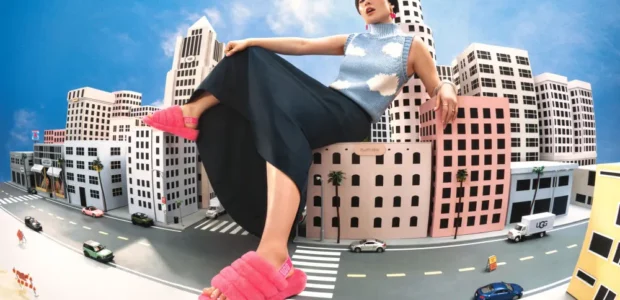

When UGG brought back its Fluff Yeah sandal on March 16, the move was driven less by nostalgia and more by sustained consumer demand, according to the brand. The style, which first launched in fall 2018 at around $100, quickly became a celebrity favorite and a breakout product for the brand.Nearly eight years later, it is returning at a slightly higher price point, now retailing at $105-$140, depending on the variation.
“We saw really strong signals across ugg.com. Consumers were actively looking for this style,” said Lindsey Dashoff, vp of marketing at Ugg North America, who declined to share related data.
According to Dashoff, search data plays a key role in identifying when a product has moved beyond trend status and into something more substantial. “We’re deeply consumer-obsessed,” she said. “Looking at those signals alongside our broader regional strategy is how we land on these [launch] moments.”
The brand framed the resulting relaunch as a larger “360 moment” spanning marketing with a campaign, retail and in-person activations.
For the campaign film, Ugg built a miniature, fully physical set in collaboration with Tastebuds Studio, designed to resemble a tiny version of Los Angeles. Distributed across Ugg’s social channels, e-commerce site and paid media, the film — inspired by “Godzilla” — shows comedian Atsuko Okatsuka, the face of the campaign, towering over the handcrafted city amid shaking coffee cups and collapsing buildings created using practical effects.
Supporting campaign content included behind-the-scenes clips highlighting the set’s hand-built elements. The content, as a whole, was amplified across digital channels and paired with real-world activations, including a Venice Beach pop-up and in-store displays. There, consumers could engage with the product in an immersive, cinema-inspired setting reminiscent of the campaign’s production set.
“When you think about Ugg, you think about softness and materiality, so it felt natural for us to bring that into the production,” said Dashoff. “AI is a very exciting tool for our industry, but for this specific launch, we really wanted to lean into craft.”
The approach stands in contrast to the increasing use of CGI and generative tools across fashion campaigns. Hugo Boss, for example, has leaned into AI-generated campaigns and digital avatars as part of its marketing strategy, testing how synthetic content can scale production and drive engagement.
Ugg has also leaned into craft for past campaigns, including its fall-winter 2025 campaign, “Iconic From the First Step,” as well as artist-led collaborations in 2023–2024 with designers including Gerrit Jacob, who created hand-painted and customized boots. The brand also incorporated craft elements in its 2022 collaboration with Quannah Chasinghorse, which highlighted Indigenous beadwork and regenerative materials, and its 2023 partnership with Seth Rogen and The Elder Statesman, which focused on hand-dyed materials and artisanal knit techniques.
As for the new “Fluff Yeah” campaign, casting Okatsuka marks a move away from more traditional celebrity partnerships. Known for her identity-driven humor and storytelling, Okatsuka brought a tone that aligned with the campaign’s focus on individuality and self-expression.
“I actually bought two pairs when they first launched,” Okatsuka said, describing her existing connection to the product. “[The campaign] just aligns so much with how I approach comedy and my style.”
What resonates with consumers has evolved since the Fluff Yeah’s initial rise, which Okatsuka knows well. During the pandemic, she built a following through direct-to-camera content and online performances that caught on.
“There was this moment where people stopped pretending. People found community by being their weird selves online,” she said.
That has influenced how brands approach storytelling, with an increased emphasis on relatability and personality over highly polished visuals. For Ugg, that has meant leaning into humor and a slightly absurd, cinematic tone rather than traditional fashion campaign aesthetics.
Okatsuka called out the importance of physical experiences in building connections with audiences. Dashoff said these touchpoints are part of Ugg’s broader push toward community-driven marketing, with more emphasis on showing up in key cities and creating experiences that bring the brand to life beyond screens.
“We’re really leaning into more personal storytelling and showing up through a community-first lens,” she said.
Overall, Ugg is working to extend the lifespan of viral moments by embedding them into ongoing storytelling, seasonal campaigns and physical retail experiences, rather than letting them peak and fade. That includes reintroducing styles when consumer demand resurfaces, supporting them with full-scale marketing and integrating them into brand narratives alongside newer products.
The brand has taken a similar approach with its Classic boot, which has been repeatedly reintroduced through seasonal campaigns, collaborations and cultural storytelling moments that keep it relevant across generations. More recently, it has also revived styles like the Tasman and Tazz slippers after renewed consumer interest, using social momentum and search demand to guide timing and support dedicated campaigns and retail visibility.
“We want to integrate these icons more into storytelling on a broader level,” Dashoff said.