

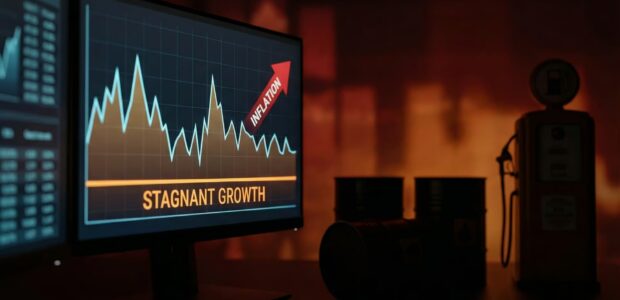

For those who believe history always repeats itself, a surge in oil prices amid a weakening economy is a scary sign.
Economists, analysts, and investors have spent the past few days sounding the alarm about stagflation, a uniquely nerve-racking scenario in which high inflation dogs a low-growth, stagnant economy. It was last seen in the United States in the 1970s, and conjures images of lines at gas stations and interest rates in the double digits.
What Experts Are Saying
“The U.S. is seeing a growth shock,” said Don Rissmiller, partner and chief economist for Strategas, in a March 8 note to investors, “and an inflation shock (higher energy prices due to geopolitics) at the same time.”
Slow growth can be easier to manage than inflation, Rismiller wrote, adding, “We are not raising our 2026 U.S. recession odds yet. They still stand at 20%. A short-lived move in energy prices can be offset with a decline in the saving rate. But it will not take much more for those odds to start climbing. We probably only have a few weeks before Middle East trade turns critical.”
And in a March 8 note to investors, famed economist Ed Yardeni wrote that he was raising the odds of his “Meltdown scenario (which now includes a 1970s-style stagflation) from 20% to 35%.”
Why Oil Prices Are Driving the Fear
Oil prices have surged nearly 40% since the start of the war in Iran, boosting prices throughout the economy and weakening the likelihood of a Federal Reserve interest rate cut. Traders now almost unanimously expect policymakers to hold rates steady at their March meeting, and most bets don’t expect any cuts until much later in the year.
But concerns about the state of the underlying economy linger, boosted by a shocking jobs report March 6, which showed a loss of 92,000 jobs in February. Under normal circumstances, that kind of slow or even negative growth might prompt the Fed to cut rates to stimulate demand.
On March 6, Chicago Fed President Austan Goolsbee told the Wall Street Journal that the current conditions create “exactly the kind of stagflationary environment that’s as uncomfortable as any that faces a central bank.”
Not Everyone Is Convinced
Not everyone is convinced the current moment is as dire as the headlines would suggest.
“I think it’s a bogeyman and I don’t see it happening,” said Peter Andersen, who manages $500 million as head of Andersen Capital Management. “I think the bigger risk now is what I call a slow grind economy.”
In an interview with USA TODAY, Andersen explained that slow growth with elevated prices for everyday items is a concern. “For most families that can feel like stagflation, even if it’s not the official explanation,” he said.
Andersen advises ignoring any one particular economic indicator in favor of looking at longer term trends. The February jobs report, for example, was concerning, but didn’t warrant the “whipsaw” reaction markets made, he said.
What It Means for Workers
Still, the underlying trend for hiring is tepid at best. Employers added only 181,000 jobs in 2025, or about 15,000 per month, the Labor Department said March 6. In such a slow-growth economy, and with coming advancements in AI technology, it’s likely that lower-level workers will feel the pinch the most, Andersen said.
“The economy looks strong at 30,000 feet but on the ground it feels much more uneven.”
This article originally appeared on USA TODAY: What is stagflation? The worry looming over the economy
Reporting by Andrea Riquier, USA TODAY / USA TODAY
USA TODAY Network via Reuters Connect