


A $10 voucher.
That’s what Angela Justice got after her recent flight from Boston to Chicago was delayed and then canceled.
“Let’s be honest, that barely covers a bottle of water,” said Justice, a consultant who advises biotech executives.
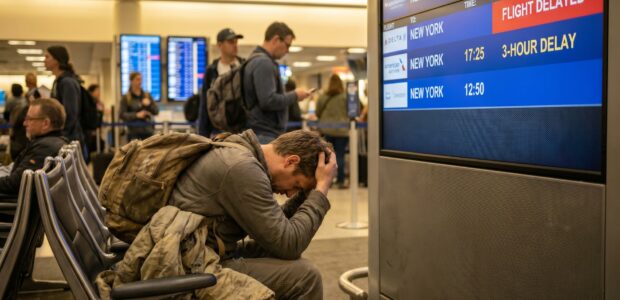
But the true cost of an airline delay — or the delay tax — isn’t always about business class travelers missing high-stakes meetings. Sometimes it’s just people like you and me trying to hold together plans, budgets, and expectations in a system built to offer vouchers instead of accountability from airlines.
A record 3.6 million passengers were predicted to travel this Memorial Day weekend. Now more than ever, the cost of a delay is a calculation more airline passengers will have to make. And unfortunately, the airline industry’s numbers are wrong.
What Is the Delay Tax?
Here’s what I’m talking about when I say “delay tax”: Nonrefundable hotels you can’t get to. The family wedding that ends before you land. Child care bills that keep ticking. Lost wages. The second flight you had to book yourself because the airline’s rescheduling timeline was useless.
These are the real costs of a system that’s pushing every risk onto travelers.
The official story is simple. When flights get delayed, airlines cover “duty of care” — a meal voucher, maybe a hotel, or a refund if the flight gets canceled. The Department of Transportation nods. Everyone acts like the problem is solved.
It’s not.
“When airlines talk about reasonable compensation, they refer to immediate, measurable costs, things like meal vouchers, hotel stays, or partial refunds,” explained Suzanne Morrow, CEO of InsureMyTrip. “But those definitions exclude a wide range of real-world financial losses travelers face when delays disrupt their plans.”
When Airline Vouchers Meet Reality
Cal Singh, who runs a financial services company in Vancouver, learned about the delay tax the hard way. A canceled flight from Toronto to New York cost his marketing team nearly $3,000 in expenses they couldn’t recover. The booth they’d assembled for a payments exposition was gone. The hotel night they’d booked? Forfeited. The express shipping they’d arranged? Nonrefundable.
“Weeks of preparation can be lost by one delay,” Singh told me.
He’s rebuilt his entire travel operation around that lesson. Every business trip now includes backup flights, refundable bookings, and extra insurance. Because he learned what airlines don’t want you to know: They’re not in the business of making you whole. They’re in the business of getting you from point A to point B. Everything else is your problem.
It’s not just business travelers, of course. Donna Glass’ experience with United tells the same story. Her recent flight from San Francisco to Orlando was delayed multiple times and then switched to a completely different aircraft. She arrived in Florida early the next morning, having spent more than 12 hours in the airport.
Her airline offered her two $15 food vouchers and 7,500 frequent-flyer miles.
“We lost an entire day in Orlando,” Donna said. “The airline basically blew us off.”
Here’s the real question regulators refuse to ask: Is that fair?
The Compensation Illusion
When airlines talk about “reasonable compensation,” they’re working from a narrow playbook. The DOT focuses on immediate, basic costs like the price of your airfare. Europe goes further with its consumer protections, offering compensation for delays. But even the strictest rules fail to account for the real-world damage caused by delays.
Airlines are just following the law. But the law was written in a different era, when travel was simpler and airlines were more generous with their passengers. Now, delays are chronic and airlines are watching every penny. Regulators haven’t caught up.
Jacob Wedderburn-Day, CEO of Stasher, an airport luggage storage network, sees the ripple effects every day. He’s watched thousands of passengers absorb costs that go way beyond a meal voucher.
“The hidden costs are very high, and the passengers pay nearly all of them,” Wedderburn-Day said. “Airlines are basing fair compensation on their own operating expenses and regulatory requirements, rather than actual economic impact on travelers.”
Maybe that’s the problem. The delay tax exists because airlines calculate compensation based on what it costs them to reschedule flights, not what it costs you to miss the reason you flew in the first place.
TinLeg, a travel insurance company, has the receipts: In 2025, the average payout per claim was $388. The single biggest culprit was airline delays. TinLeg found that nearly 28% of all claims were tied to flight delays — up from 26% in 2024.
Sometimes, airlines will voluntarily cover some of your expenses, such as toiletries or a change of clothes — to a point.
Even When Airlines Are Generous, There’s a Catch
If you can get an airline to compensate you for your expenses — which can happen — there’s a problem that customers create for themselves. Raymond Yorke at Redpoint Resolutions has watched travelers leave money on the table because they didn’t document everything.
“The travelers who get reimbursed quickest are almost always those who kept receipts, took photos, saved emails, and wrote down what happened — in real time,” Yorke says.
A safer bet is to buy travel insurance, but you still have to keep your documentation for some claims. (With bigger travel insurance companies, flight delay claims are automatic and don’t require any documentation.)
“A proper travel protection plan can fill the gap airlines won’t,” said Carlos Cividanes, vice president of business strategy and development at TravelSafe Travel Insurance.
But even travel insurance won’t end the delay tax.
What Needs to Change?
Justice’s point about the cascading effects of delays is central to understanding why the current system is broken. It treats delays as isolated incidents affecting one person. But when you’re running a company, leading a team, or managing a critical life moment, a delay ripples outward.
Michal Strahilevitz, a professor of marketing at Saint Mary’s College of California who studies business ethics, thinks the whole compensation framework is backward.
“Airlines do not compensate passengers for pain, suffering, or emotional distress caused by delays,” she said. “But in an ideal world, they would at least try.”
The data backs that up. AirHelp surveyed Americans and found that 46% lost money on their last flight disruption.
“Airlines need to be financially responsible for the total economic cost of delays that they incur, and not merely direct costs,” said Wedderburn-Day of Stasher. “There is no incentive yet to change because travelers all bear downstream costs. The model changes only when airlines start to experience the financial bite of chronic unreliability.”
That’s true. Right now, airlines have no reason to operate more reliably because they don’t pay the true cost of delays. The expense is yours to bear. Until that changes, expect more delay taxes.
So here’s my advice: If you’re planning to fly, build redundancy into your bookings. Get insurance. And document everything. Because airlines won’t make you whole. The system isn’t designed to do that.
At least, not yet.
Christopher Elliott is an author, consumer advocate, and journalist. He founded Elliott Advocacy, a nonprofit organization that helps solve consumer problems.