

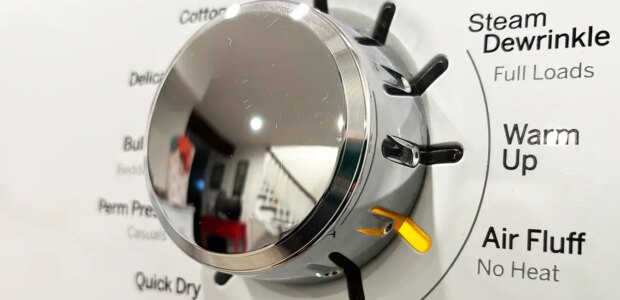

If you’ve ever found yourself trying to vacuum your curtains, puff up your pillows, or shake the dust out of a pile of stuffed animals, you could’ve put them in the dryer instead.The air-fluff cycle — sometimes called “air-dry” or “no heat,” depending on the brand — can tumble and filter away much of the stale-smelling, sniffle-inducing funk that builds up in the soft, fuzzy, hard-to-launder items around your house. It’s a lot less tedious and probably more effective than trying to do it all by hand.The way it works: The dryer’s tumbling motion knocks the dust loose, and then the room-temperature air flowing through the drum sweeps the floating debris into the lint trap.It’s a gentle, no-heat cycle, so there’s minimal wear and tear on even the most sensitive materials, such as velvety fabrics or down. Plus, it uses very little energy.Dryers are remarkably similar from brand to brand, and any model with an unheated tumble setting can safely dust your stuff, including most of the ones we recommend at Wirecutter and even some of the cheapest dryers available in stores. Some internet-connectable models offer it as a downloadable cycle, which is obnoxious.But most dryer brands don’t acknowledge this killer use case for their no-heat cycles. The exception that I’ve been able to find is Whirlpool and its sister brand, Maytag. (I actually stumbled across this tip in one of their user manuals when I was working on Wirecutter’s guide to dryers a few years ago.)Several brands that make fuzzy pillows and blankets actually recommend a no-heat tumble to clean their products, particularly if the outer fabric is heat-sensitive or the inner stuffing is thick foam.Upscale interior-design firm Calico suggests it’s an excellent way to clean drapery. They actually recommend adding a damp hand towel to the dryer drum to help catch dust motes.You could also add a set of dryer balls to the drum to knock extra dust loose and help fluff up the stuffing in your pillows or comforters. I’ve tried it, and it certainly doesn’t hurt anything, though it’s probably not necessary for a load full of smaller stuffies because they tumble enough on their own.Wool dryer balls can help knock some extra dust out of pillows and comforters while also helping to fluff up the filling. And they’re much quieter than tennis balls.A few dryers — including some Miele units we otherwise love — don’t offer an air-fluff cycle at all. So if you don’t have access to a no-heat mode, you could try setting your dryer to the lowest heat setting available, for the shortest possible cycle time (usually 10 or 15 minutes), and you should get similar dust-reducing results. Just be careful trying this with heat-sensitive materials.There are also some limits to what you can actually fit in the drum. My couch’s seat cushions are the bulkiest items I’ve ever managed to wedge into the dryer for air-fluffing, but in hindsight I don’t think this is the best way to dust them. They’re too big to tumble much, so very little debris gets knocked loose; you’d be better off using a vacuum or taking them outside for a good beatdown with a stick or tennis racket.Runner-upMiele canister vacuums are built to last, and they don’t leak air. This model doesn’t come with a HEPA filter, but you can add one later if the standard air-quality package isn’t cutting it.Unlike vacuums or air filters, there’s no research on a tumble dryer’s ability to remove dust and improve indoor air quality. “I am going to guess that it does make things better, but I have no real evidence on this,” said Jeffrey Siegel, PhD, a professor at the University of Toronto specializing in building engineering and indoor air quality.From my personal experience, the air-quality improvement seems real. After I toss my daughter’s small mountain of stuffed animals into the dryer, I notice fewer specks floating in front of her bedside reading light, at least for a couple weeks. When the pillows and blankets we keep on the couch go for a tumble, it seems to cut down on our occasional throat-clearing and sneezing while we watch TV.Top pickThis portable HEPA filter is one of the highest-performing, most durable, and most economical models we’ve tested. It’s a great tool for sucking up dust before it lands on hard-to-clean surfaces.In general, the best way to control dust is to set up a high-quality air purifier in your house, whether it’s a portable HEPA filter or a central HVAC filter with a high MERV rating. Regularly cleaning your floors with a well-sealed vacuum also helps.But dust inevitably builds up everywhere, and when it makes sense, using your dryer to manage it is a no-brainer.This article was edited by Megan Beauchamp and Maxine Builder.Further reading
Source link