

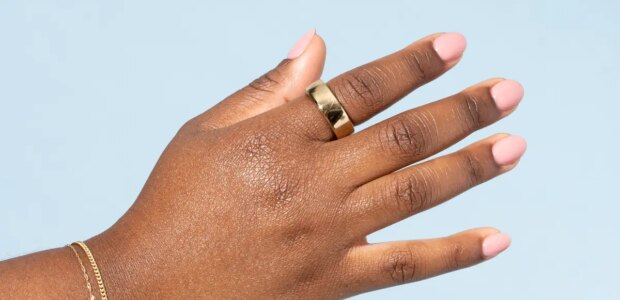

Oura has improved its tracker’s sensing accuracy. The most notable upgrade of the fourth-generation ring is its “smart sensing” algorithm. The sensors are now recessed and asymmetrically positioned, in contrast to the three bumps in the Gen3. The smart sensing algorithm chooses which sensors to pull data from at any given moment, improving the accuracy of its findings. It essentially finds the path of least resistance — through your unique finger size, blood vessels, or skin tone — to deliver constant data throughout the day.The app’s data is easier to read and digest. Oura’s app, like many fitness apps, throws a lot of data at you in the form of color-coded charts and graphs. But unlike the past iteration of its software, the updated Oura app, accessible to both Gen3 and 4 wearers, includes explainers for anything you may not understand.The app also has Trends and Reports tabs that help to synthesize all of your collected data: The Trends tab’s graphs show you how your Sleep, Activity, Readiness, and Stress scores have averaged over a week. The Reports tab gives you that same data in monthly, quarterly, and yearly intervals.The Oura app no longer requires you to tap each score to see its details. Instead you can see your daily scores, your health metrics, and your health trends in three separate tabs: Today, Vitals, and My Health. This arrangement made it much easier for me to interpret my data at a glance. Oura’s updated app now has a Today tab for at-a-glance insights, a Vitals tab for in-depth information on each score, and a My Health tab for your heart health, resilience, and sleep health. It also offers a “check in” feature, where you can indicate any activity that affected your sleep.It’s lighter, sleeker, and more comfortable. The Oura Ring looks and feels like a piece of jewelry, akin to a wide wedding band. The fourth-generation version comes only in the “smooth” style, whereas the Gen3 came in both “smooth” and “heritage,” a flat design with squared-off edges. But it’s available in multiple finishes — silver, black, matte black, stealth, gold, and rose gold — so it can fit seamlessly with your personal style. I have tested the gold and rose gold finishes and found them understated yet chic.Thanks to the lighter, smoother design, the new ring feels more comfortable while I’m doing everyday things (such as shaking hands) and is less disruptive while I’m sleeping. I used to take off my Oura Ring Gen3, for example, when I was cooking or doing my hair, because the thickness of the ring made gripping something like a knife or a hairbrush difficult.The Oura Ring is water-resistant, too, and it can withstand temperatures from 14 °F to 129 °F. However, I prefer to take it off while washing my hands, showering, or swimming.Oura has also expanded the size range, which now extends from 4 to 15 (in contrast to the Gen3’s range of sizes 6 to 13).The battery life has been improved. During our previous testing, the Oura Ring Gen3 needed recharging every five to seven days, but the Oura Ring 4’s hardware, partly thanks to the automatic adjustment of the LED brightness, can last up to eight days before needing to recharge. (Note: The Oura Ring’s blood-oxygen monitoring can cause the battery to drain significantly faster, but you can turn that function off.)Some Gen3 wearers have raised concerns on Reddit about the battery’s dying faster over time, to the point where it needs recharging every 24 hours. I contacted Oura about this issue, and representatives said that the company will replace your Gen3 ring if you have battery issues, even if it is outside of Oura’s one-year warranty. We did not encounter this issue with the Oura Ring 4. The Oura Ring 4 can run for up to eight days on a single charge (with blood-oxygen monitoring disabled). Other wearable sleep and fitness trackers require more frequent charging. Connie Park/NYT WirecutterIts HRV tracking and Symptom Radar feature are impressively accurate. The Oura Ring was one of the first smart rings to measure HRV, or the regularity (or irregularity) of the time between pulses. High HRV is generally good; it suggests you’re relaxed and well. Low HRV (when the time between heartbeats is consistent, without much variability) may be associated with physical or emotional stress.When I tested the Gen3, the ring was able to detect my very low HRV while I grieved a death in the family. With the Oura Ring 4, the HRV sensors allowed the app’s Stress Resilience feature to accurately measure my stress levels during exhausting travel days and high-intensity exercise classes.Oura’s Symptom Radar is calculated from biometrics such as body temperature, respiratory rate, resting heart rate, and HRV. It notifies you of potential strain at three severity levels: no signs, minor signs (small indicators that something may be straining your body), and major signs (stronger indicators).Anecdotally, the Symptom Radar feature alerted me that my “biometrics showed major signs of something straining” my body long before I knew anything was wrong. Lo and behold, hours later I couldn’t stop sneezing and had to nurse a cold soon after.(Note that Oura says that the Symptom Radar feature may not work with preexisting conditions that already cause elevated biometrics. For instance, Oura’s algorithm may accurately detect real change in the body that it would identify with illness when the symptoms may actually be reflecting an underlying condition, such as pregnancy.) Left: The Oura app told me (and showed me) that I had experienced a stressful day, while asking me to reflect on what made it stressful and gently nudging me to remember to rest afterward. Right: The Oura app told me that my day was restorative without making me feel bad for taking it easy.Its recommendations are personalized, without being pushy. The Oura app gives suggestions for steps that you can take to be more active, to rest more, or to sleep better (and thus improve your three scores). I found that Oura’s recommendations were more personalized and more achievable than those of some other sleep tracker apps I tested. For example, instead of repeatedly telling me to be in bed by 10 p.m. (something that was never going to happen), the app adapted to my sleep habits and recommended a new, more realistic bedtime and wake-up goal for my “chronotype.”If I woke up feeling groggy, the app might suggest that I enter Rest Mode. Caroline Kryder, product manager and women’s health lead at Oura, explained that the app will encourage Rest Mode if your temperature is elevated, your heart rate looks off, or your body is showing signs of strain.I took it as a delightful cue to head back to Wordle or, even better, go for a nap. Then, when the app had noted that I had logged some downtime, it would nudge me to put my newfound energy into action — in other words, to take a walk. After a while, I started feeling like I had developed better habits with these bits of gentle encouragement, rather than scolding.
Source link