


Last time I stopped at Publix, I spent about $140. Publix bought nothing from me. Not a thing.
By the definition the president used this week, I took a $140 loss.
I didn’t. I came home with groceries I wanted more than I wanted the $140, and Publix wanted my $140 more than it wanted the groceries. Both sides walked away better off. That’s what a trade is.
I’m not explaining this to criticize the president or the government. This isn’t political. My job is to help you understand the economy, which includes calling out misinformation, whatever the source.
Here’s what happened in this case.
On Sept. 16, hours after the Federal Reserve raised its benchmark rate a quarter point to 3.75%-4.0%, President Donald Trump posted on Truth Social that the word “deficit” is nothing more than a fancy word for loss, and that the U.S. is carrying almost every country in the world.
He also said that cutting off trade with every country we run a deficit with would bring in at least $1.5 trillion a year.
I’ve been a CPA since 1981. I also spent a decade on Wall Street. I’ve prepared and read a lot of financial statements, and I can tell you that a loss is a specific thing with a specific definition. A trade deficit isn’t it.
But three different things get called “deficit” or “debt” in the news, and only two of them can actually reach into your wallet. Let’s go over them.
A trade deficit isn’t a loss
A trade deficit is the gap between what we buy from a country and what we sell them. That’s it. It’s a description of a flow of goods, not a scorecard.
You run a trade deficit with your grocery store, your dentist and your barber. They don’t buy anything from you. Nobody thinks you’re losing.
Countries work the same way, with one addition. The dollars we send overseas don’t disappear. They come back, mostly as investment in U.S. Treasury bonds, U.S. stocks, U.S. real estate and U.S. businesses. A trade deficit in goods is largely matched by a surplus in investment coming the other direction.
That’s the part the “loss” framing misses entirely. Nothing was lost. It changed form.
The U.S. ran a goods and services trade deficit of about $901.5 billion for the full year in 2025, according to Commerce Department data. That’s a big number. It’s also been big for decades, through booms and recessions alike, which should tell you it isn’t a reliable measure of whether we’re winning or losing anything.
A budget deficit is closer, but still isn’t a loss
Now we switch subjects. The budget deficit has nothing to do with trade.
It’s the gap between what the federal government spends in a year and what it collects in taxes. In fiscal 2025, the government spent about $7.01 trillion and collected about $5.23 trillion, according to the Treasury Department. The roughly $1.8 trillion difference is the deficit.
Is that a loss? Closer, but no. When a business takes a loss, the owners’ equity shrinks. When the government runs a deficit, it borrows the difference by selling Treasury securities.
That’s not a loss on a statement. It’s a bill that gets paid later, with interest, by taxpayers. Which is worse in some ways and better in others, but it isn’t the same thing.
Real talk — I’ve made plenty of money mistakes in my life, and I’ve spent decades helping people sidestep the ones they don’t have to make. Sign up for the free Money Talks Newsletter and let my scars save you a few of your own. Free, and worth more than that.
The national debt is the pile all those deficits made
Third term, third meaning. The national debt is every past deficit stacked up, minus the handful of surplus years, plus interest.
As of Sept. 11, that total stood at just over $40 trillion, per the Treasury’s daily Debt to the Penny report.
The clean way to keep these straight: the deficit is the flow, the debt is the level. One year’s shortfall gets added to the pile. The last time the pile shrank on an annual basis was 2001.
Only two of the three touch your budget
Here’s the part that matters to you.
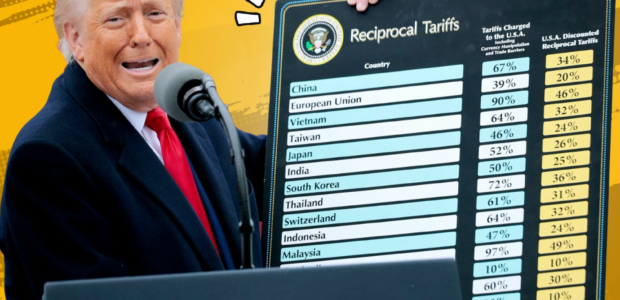
The trade deficit doesn’t show up in your monthly bills in any direct way. Tariffs do, because you pay them with higher prices. The Tax Foundation estimates the average household tariff cost is headed toward $1,300 in 2026. But the trade gap itself isn’t a charge against you.
The budget deficit and the national debt do reach you, and they use the same delivery route: interest rates. Every dollar the Treasury borrows is a bond somebody has to be persuaded to buy. More borrowing means more supply, and more supply tends to push yields up.
Treasury yields set the floor for your 30-year mortgage. They influence car loans, and the interest on the debt eats a growing share of the budget before a dollar goes anywhere else.
So when someone tells you the deficit is costing you money, ask which deficit. If they mean the budget deficit, they’ve got a real point. If they mean the trade deficit, they’re describing your Publix receipt.
About that $1.5 trillion
One more claim worth taking apart, because it follows directly from the confusion.
The president said that cutting off trade with every country we run a deficit with would bring in at least $1.5 trillion a year. Trade isn’t a subscription somebody pays us. Ending it doesn’t produce revenue.
What it produces is the absence of the imports. No more coffee, bananas, cell phones, generic drugs, auto parts or the thousand other things we buy from abroad because buying them beats making them here.
You’d feel that within a month, at the register, when you have to buy goods from different, more expensive sources, whether foreign or domestic-made.
Nobody collects $1.5 trillion. That number is the size of a gap, not money that shows up anywhere. What actually happens is you keep buying, from somewhere else, at a higher price.
Meanwhile, the thing actually moving your borrowing costs went the wrong way recently. If you’re carrying a credit card balance or a home equity line, that repricing hits within a billing cycle or two. “5 Money Moves to Make Now If the Fed Raises Rates Instead of Cutting Them” walks through what to do about it.
Words matter here, because the wrong word leads to the wrong policy, and the wrong policy shows up in your grocery bill. A deficit isn’t a loss. It’s a gap. What the gap costs you depends entirely on which gap you’re talking about.