


For years, the beauty industry’s most common indie success stories followed a predictable arc: A founder identifies a market gap, licenses a ready-made formula from a contract manufacturer, customizes fragrance or texture, and builds a brand around storytelling and packaging. That model fueled countless buzzy launches, but it also left much of the industry’s real power concentrated elsewhere.Today, founders question who actually controls beauty’s supply chain. Across hair care and skin care, a growing number of Black and Brown founders are moving upstream away from formula buying and toward formula ownership, lab control and even ingredient development. The result is a shift in beauty’s infrastructure, one that affects margins, innovation speed, retail credibility and who ultimately decides what “performance” looks like.From buyer to builderThe distinction between buying a formula and owning one may sound subtle, but the implications are structural. Many emerging brands rely on white-label or private-label bases — pre-existing formulas licensed from third-party labs, often without full intellectual property rights. Even custom formulas are frequently manufactured externally, leaving brands dependent on minimum order quantities, long lead times and shifting production costs.By contrast, founders who control formulation and manufacturing gain leverage: faster iteration, greater pricing flexibility and the ability to meet retailer demands without compromising performance. The trade-off? That control is expensive and slow to build — but increasingly, it’s becoming a competitive advantage rather than a luxury.Ancestral knowledge, industrial scale
Photo: Courtesy of Chéribé
Chéribé founder Salwa Petersen exemplifies this shift. Built around chébé, a seed used for generations by women in Chad, the hair-care brand is the result of eight years of research, farming and lab development prior to its January 2025 launch.Rather than licensing the ingredient or outsourcing formulation, Petersen chose to build and own the full supply chain. After validating the ingredient through scientific testing, she established a vertically integrated model spanning regenerative farming, proprietary extraction methods and pharmaceutical-grade formulation.”That was the moment I realized we weren’t just preserving a tradition — we had uncovered a high-performance biological asset the industry had never seen,” says Petersen. Today, she owns the Chébé trademark, formulations, clinical protocols and sourcing — a deliberate decision in an industry where many founders don’t own much more than their brand names (if that).”Ownership is the difference between being a face and being a force,” she says. “For too long, Black founders were expected to provide marketing or diversity optics. Ownership is how you ensure your brand isn’t sidelined or stripped of its power.”Legacy labs and long timelines
Photo: Courtesy of Design Essentials
While Chéribé represents a new generation of vertically integrated brands, Design Essentials shows how manufacturing ownership often takes decades — not months — to achieve. The hair-care brand’s parent company, McBride Research Laboratories, is one of the few Black-owned beauty companies with in-house R&D and manufacturing at scale.”Owning our manufacturing gives us control over quality, speed and intention,” says Cornell McBride Jr., president of McBride Research Laboratories. “When your lab is in-house, you can test and refine formulas in real time and tailor innovation specifically for textured hair.”That control extends to pricing and accessibility. Internal manufacturing allows efficiencies that help maintain affordability while delivering professional-grade performance — something that’s more difficult to sustain when margins are eroded by third-party production.
Photo: Courtesy of Design Essentials
Still, the journey was long. Design Essentials didn’t begin manufacturing its own products until roughly 25 years into the business. “Building that capability took time, patience and intentional investment,” McBride says. “Talent, capital and infrastructure remain the biggest barriers.”Still, for McBride, the difference between brand ownership and supply-chain ownership is critical. “A Black-owned brand is visibility,” he says. “Black-owned supply-chain power is sustainability.”Manufacturing as resilience
Photo: Courtesy of Oyin
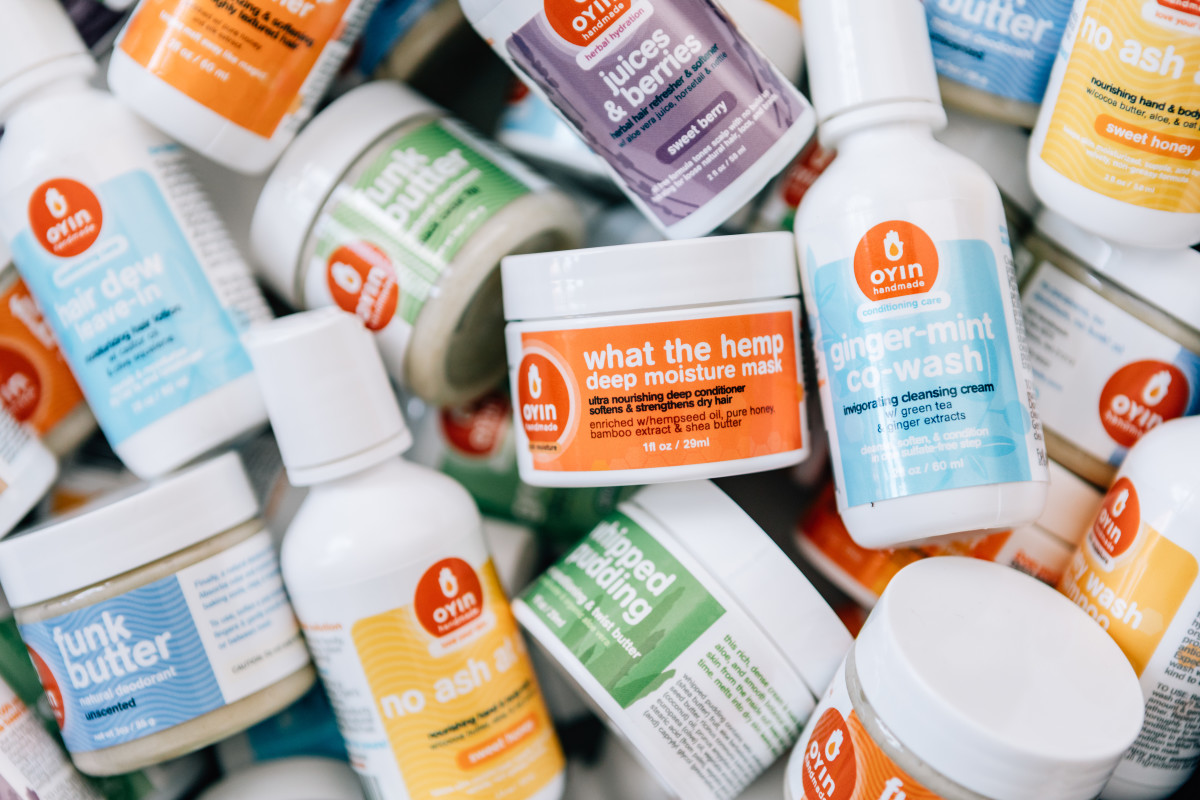
At Oyin Handmade, manufacturing ownership has been less about prestige and more about survival. Founded by Jamyla Bennu in her kitchen and now operating an in-house manufacturing facility in Baltimore, the brand resisted outsourcing even as it expanded into mass retail.”We kept production internal to protect the integrity of our formulas,” Bennu says. “We watched brands scale, outsource manufacturing and suddenly customers would say, ‘It doesn’t work like it used to.'”Self-manufacturing also proved crucial during supply-chain disruptions like during the pandemic. “When manufacturers raised minimums or paused smaller clients, we could pivot,” Bennu says. “That flexibility kept us operational.”For Bennu, local manufacturing is also a form of community investment — long-term hiring, student factory tours and the cultivation of regional manufacturing ecosystems that support other makers.The science behind the shiftFor AJ Addae, founder of Sula Labs, manufacturing ownership is about closing what she calls “inclusivity gaps” in beauty R&D. “Melanin-rich skin and textured hair were left out of beauty R&D for decades,” says Addae. “Representation at the lab level changes what questions get asked — and which products even make it to market.”At Sula Labs, Addae has developed proprietary testing and formulation protocols designed specifically for melanin-rich skin and textured hair, combining academic research with applied product development. But she notes that infrastructure remains a key barrier.”Advanced equipment, stability testing and regulatory compliance are expensive,” she says. “Access to lab infrastructure determines whether innovation stays theoretical or actually reaches shelves.”
Photo: Courtesy of La Roche-Posay
That shift isn’t only about brand building; it’s also being recognized inside established, global beauty R&D organizations. At La Roche-Posay, part of L’Oréal’s dermatological beauty division, inclusive product development is increasingly a scientific mandate rather than a marketing consideration.Janet Wangari-Olivero, Ph.D., AVP of clinical research & medical affairs at La Roche-Posay, L’Oréal USA, points to the development of the brand’s Mela B3 franchise — formulated around Melasyl after nearly two decades of research — as an example of how representation in R&D changes outcomes. Beyond addressing hyperpigmentation across skin tones, the launch required rethinking clinical testing models and product formats, including a daily SPF designed to avoid the white cast that often prevents people of color from using sun protection consistently.That level of rigor, Wangari-Olivero notes, isn’t just about inclusivity — it determines which innovations are scalable, credible and capable of earning long-term consumer trust.Related: L’Oréal Put 18 Years of Research Into a New Ingredient That Addresses Dark SpotsAt Unilever, inclusive innovation must be designed from the outset. “Inclusive product creation isn’t an afterthought,” says Tiffany Yizar, the beauty conglomerate’s head of R&D for Beauty & Wellbeing North America. “It’s a design discipline.”That approach reflects a broader shift in how innovation is evaluated at the institutional level. At La Roche-Posay, Wangari-Olivero says a product is no longer considered innovative unless it performs across skin tones, hair types and lived experiences — a standard increasingly shaped by Gen Z’s demographic reality.”We’ve moved far beyond just adding shades,” she says. “It’s about the science of undertones, the physics of hair and designing formulas that respect the structure of the skin or hair they’re meant for.” That mindset has pushed R&D teams to rethink testing models, from pigment development to curl classification systems based on fiber structure and moisture needs rather than ethnicity.
Photo: Courtesy of La Roche-Posay
For Wangari-Olivero, representation in the lab isn’t symbolic, it’s operational. “Diversity of minds reduces blind spots,” she says. “When the people formulating products have lived the frustration of a formula that doesn’t work for them, they bring an empathy you can’t get from a textbook.” As the U.S. moves toward a majority-minority population by 2045, she sees this rigor as essential to the future of beauty innovation.Retail pressure and the new gatekeepingRetail programs are increasingly prioritizing compliance and supply-chain readiness over brand storytelling alone, a shift multiple founders say has raised the bar for emerging brands.Alongside compelling narratives, retailers and incubators are now also asking for proof of scalability: stability testing, regulatory compliance, inventory continuity and supply-chain transparency. That shift favors founders with deeper control over formulation and manufacturing, but it also exposes longstanding bottlenecks across the industry.Capital requirements, high minimum order quantities, regulatory complexity and inventory financing continue to limit who can scale manufacturing operations. Without intentional investment from retailers, financiers and accelerators, experts warn that ownership will remain concentrated among founders who can afford long runways.What comes nextAs Gen Z pushes for performance, transparency and cultural relevance simultaneously, manufacturing ownership is emerging as a quiet differentiator. Brands that control their science, supply chains and testing standards aren’t just launching products — they’re reshaping how innovation happens.”The future of beauty manufacturing will be powered by diverse voices who understand the consumer,” McBride says. Or, as Petersen puts it more pointedly: “The next phase of textured hair care will be powered by the daughters of those who invented hair care on Earth.” Behind the shelves, the architects are no longer invisible — and the industry is beginning to reckon with what true ownership really means.Please note: Occasionally, we use affiliate links on our site. This in no way affects our editorial decision-making.Do you have an emerging brand you want to share with Fashionista readers? Jumpstart your business with our affordable digital offerings.
Source link