

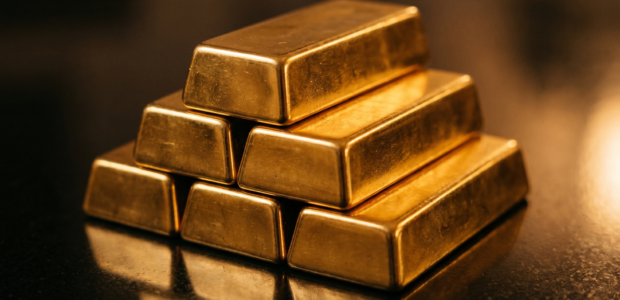

Early this year, gold passed $5,000 an ounce for the first time. These record highs were stoked by geopolitical uncertainty, shifting Federal Reserve policy expectations and strong central bank demand.
Now investors are wondering: Was the $5,000 level just a brief spike that won’t be repeated anytime soon? Gold has pulled back since January’s record highs, hovering around the low-$4,000 range, but several factors could push gold back up in the long-term.
Here’s the outlook for gold prices and what’s driving prices now, according to experts.
Why Gold Might Not Hit $5,000 Again Before 2027
The price of gold spiked above $5,000 an ounce this year but a number of forces could keep it below that peak in the coming months.
That’s because a relatively strong U.S. dollar, higher interest rates and suppressed demand in global markets are putting downward pressure on gold prices.
However, some of these conditions are temporary. Several possibilities, like lower rates, decreased trust in the U.S. dollar and geopolitical shocks, could easily lift gold above $5,000 again.
“It’s unlikely this year, but the year after is very likely,” says Purba Mukerji, professor of economics and expert in international finance and trade at Connecticut College.
Steve Maitland, a research analyst at Maitland Wealth, agrees that a return to $5,000 is possible, but that it probably won’t happen in 2026.
“The price of gold has already had a good run and the markets do not always have a one-directional trend. It is common for markets to consolidate before moving up again,” he says.
Rising Interest Rates Are Pushing Gold Lower Right Now
Right now, geopolitical tensions like the Iran war and tariffs are driving inflation fears. Because of this, traders are largely expecting the Federal Reserve to raise interest rates by the end of the year.
When interest rates go up, real yields tend to get higher. When this happens, investors can get higher returns from other interest-bearing assets, like bonds, rather than gold. This makes gold less attractive to investors, lowering its price.
Weak Demand in India Is Dragging on Global Gold Prices
Gold-buying restrictions in India this year, amid the ongoing war in Iran, are also a reason for softening global demand.
When India reduces gold imports, demand falls. This puts downward pressure on prices and helps explain why gold is hovering below record highs.
“India … is a major player in the gold markets,” Mukerji says. “This year, India has been discouraging its citizens from buying gold in hopes that it will help the value of the Indian Rupee.”
Why India Wants to Decrease Gold Demand
Mukerji explains that demand for foreign currency in India is already high due to elevated oil prices amid the ongoing war in Iran. High oil prices mean India is spending more foreign currency than usual to import fuel, as oil is priced in dollars. This puts its foreign exchange reserves under pressure.
When India also imports large amounts of gold, this further increases demand for foreign currency, which can weaken the Indian Rupee. India’s gold-buying import restrictions are designed to prevent that.
Central Bank Buying Is Supporting Gold in the Long Term
Central banks have been buying gold at high rates in recent years as a response to economic turbulence. “Central banks bought over 240 tonnes in Q1 2026 alone and they’ve been above 850 tonnes a year for three straight years,” says Luciano Duque, CEO of C3 Bullion.
While other factors have pushed gold below $5,000 since January’s record peaks, sustained buying from central banks is a key factor in keeping gold prices high over the long term.
Why Central Banks Buy Gold
Central banks buy gold to protect against geopolitical risks (like sanctions), store value and diversify their holdings. Owning gold is a major way for central banks to create financial stability through economic turbulence.
Weakening Confidence in the U.S. Dollar Could Lift Gold Over Time
The U.S. dollar is relatively strong right now. Because gold is priced in U.S. dollars, that makes gold more expensive for global buyers, reducing demand and keeping gold prices lower.
However, there are long-term forces that could weaken the dollar, like high U.S. debt. When the dollar weakens, gold prices increase as people look for alternative ways to store their wealth.
“Gold is increasingly being looked at as a confidence factor during uncertain times,” Maitland says.
High U.S. Debt and Borrowing Can Weaken the Dollar
In 2026, the U.S. national debt reached the size of the entire U.S. economy for the first time since World War II. And while borrowing has been trending up for decades, recent spikes in spending from the COVID-19 pandemic and Iran war have further raised concerns about how sustainable the U.S. debt level is.
That’s because as U.S. debt grows, investors start to worry whether the government can repay what it owes, and whether it will need to print more money to keep interest rates lower and pay back its obligations. This may lead to long-term erosion of confidence in the dollar’s long-term value. When this happens, investors turn to gold or other currencies they believe store value better.
So, Is Now a Good Time to Buy Gold?
Although global conditions impacting the price of gold continue to change, gold remains a strong store of value that many investors use for wealth preservation.
Right now, gold prices are below the record highs we saw in January of this year. But Mukerji believes that long-term prices will trend up.
“I think this is an excellent time to buy the dip,” she says.
Bottom Line: Gold Will Likely Return to $5,000, but Short-Term Headwinds Remain
Although gold will likely return to $5,000 at some point, several factors are weighing on demand right now. The dollar remains strong, interest rates are relatively high and short-term market dynamics put downward pressure on prices.
Still, longer-term factors, like supply constraints, eroding trust in the U.S. dollar and global uncertainty, make an increase in gold prices likely, with some experts expecting gold prices to surpass $5,000/oz again in 2027.
Reporting by Faith Wakefield, USA TODAY / USA TODAY
USA TODAY Network via Reuters Connect